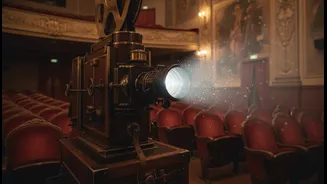












An Uncompromising Vision
Christopher Nolan doesn't just make movies; he crafts cinematic events. Central to this is his unwavering commitment to shooting on large-format film, especially IMAX 70mm. For his latest epic, 'The Odyssey,' released in July 2026, he went further than
ever, making it the first feature film shot entirely with IMAX film cameras. This format, which uses massive celluloid frames running horizontally through the camera, produces an image of unparalleled size, clarity, and resolution—nearly ten times larger than standard 35mm film. The result is a uniquely immersive experience with a tall 1.43:1 aspect ratio that fills the entire height of a true IMAX screen, something Nolan believes is essential for a story as grand as Homer's myth. The success of 'Oppenheimer' proved audiences will seek out this premium experience, with fans traveling across borders for sold-out 4 a.m. shows.
A Kingdom of Vanishing Screens
The single biggest hurdle is the stark scarcity of theaters equipped to project IMAX 70mm film. As of July 2026, only 41 such theaters exist in the entire world. Of those, 25 are in the United States, nine are in Canada, and a mere handful are scattered across the United Kingdom and Europe. There are no compatible theaters in Asia, Africa, or South America, making a true global release in Nolan's preferred format impossible. The reason for this decline is simple: economics. Over the last two decades, the vast majority of cinemas transitioned to cheaper, easier-to-manage digital projection systems. This led them to dismantle the complex and bulky film projectors, a move that made financial sense but has now created a premium-format bottleneck.
The Herculean Task of Distribution
Even for the few theaters that can show it, getting 'The Odyssey' on screen is a monumental challenge. An IMAX 70mm print is a physical beast. The film for 'Oppenheimer' was reportedly 11 miles long and weighed over 600 pounds; the print for 'The Odyssey' is said to be even heavier. These aren't digital files sent over the internet; they are massive reels shipped in heavy-duty cases that must be carefully handled and assembled on-site. A single hour-long reel can weigh 300 pounds. This analogue process is expensive, slow, and requires a tightly controlled supply chain to deliver the prints to each specific cinema. It's a far cry from the instantaneous, worldwide distribution possible with digital copies, adding significant cost and complexity for the distributor, Universal Pictures.
The Lost Art of the Projectionist
Beyond the hardware, there's a critical human element. Running an IMAX 70mm projector is not a push-button operation; it's a skilled craft. A trained projectionist is required to splice the massive reels together onto platters as large as six feet in diameter, thread the enormous machine, and monitor the screening to ensure flawless performance. This is a dying art. As theaters went digital, the demand for these skilled technicians evaporated. Now, with a film like 'The Odyssey,' theaters must find and sometimes re-train staff capable of managing these powerful and temperamental machines, adding another layer of difficulty to the exhibition process. It's a specialized skill set that simply doesn't exist in most modern multiplexes.
The Multi-Million Dollar Gamble
For IMAX and the select few theaters, showing 'The Odyssey' this way is a high-stakes gamble. IMAX CEO Richard Gelfond has noted that new 70mm film projectors haven't been manufactured in decades; the company must find and retrofit old machines to meet demand. Some theater chains, like Cinemark, and even institutions like the Tennessee Aquarium, have brought retired projectors back into service specifically for this film, a costly investment for what might be only one or two movies a year. The payoff is immense prestige, the ability to charge higher ticket prices (upwards of $30), and turning the movie into a must-see cultural event. The demand is clearly there, with screenings selling out weeks in advance. This success makes the enormous effort worthwhile, creating a status symbol out of a movie ticket and reaffirming the power of a truly epic cinematic experience.