






A Galaxy in Decline
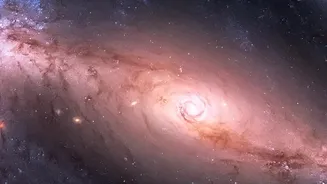
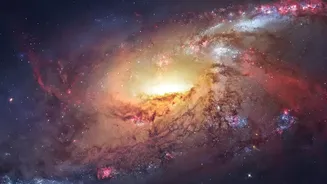
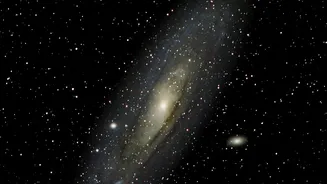
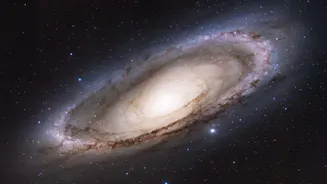
Just like people, stars and even entire galaxies have life cycles. They are born, they mature, and they eventually fade. For the Andromeda galaxy, a majestic spiral of an estimated one trillion stars, that final phase has begun. Astronomers refer to this
process as “quenching,” where a galaxy’s ability to form new stars steadily decreases. It’s a slow transition from a vibrant, blue-hued galaxy teeming with hot, young stars to a quieter, redder entity dominated by an aging stellar population. A new study reveals this process is well underway in Andromeda. Data shows that 500 million years ago, the galaxy was creating stars at a rate of about one solar mass per year. But that rate has been steadily falling, with a particularly sharp drop in the last 40 million years to just one-fifth of a solar mass annually.
Reading the Fossil Record
To uncover this slow decline, astronomers turned to the Hubble Space Telescope, which has spent years conducting meticulous surveys of our neighbour. By combining two massive observation programs—the Panchromatic Hubble Andromeda Treasury (PHAT) and its southern counterpart (PHAST)—scientists created an unprecedented map of about two-thirds of the galaxy’s sprawling disk. This effort allowed them to analyze roughly 200 million individual stars. According to the research team, these stars act as a “fossil record” of the galaxy’s past activity. Massive stars burn hot and blue but have short lifespans, so their presence signals recent star birth. Smaller, redder stars live much longer and thus dominate regions where star formation ceased long ago. By mapping these stellar populations, astronomers could effectively rewind time and watch Andromeda’s history unfold.
The Fading Star-Making Rings
The analysis revealed a galaxy that had a major burst of activity about two billion years ago, likely the result of a merger with a smaller galaxy. Since then, however, it has been on a long, slow cooldown. This isn't because Andromeda is running out of the gas and dust needed to make stars; rather, it appears to be a natural settling after a more energetic youth. The new research shows that much of the recent decline is concentrated in a prominent ring of star formation located about 32,000 light-years from the galactic center. This once-bustling stellar nursery is where the slowdown is most apparent, driving the overall decline of the entire galaxy.
A Cosmic Whodunit
While much of the slowdown seems to be a natural aging process, astronomers have also identified a potential external influence. The new Hubble map revealed a “dead zone” in Andromeda’s disk, an area nearly devoid of recent star birth. This quiet patch is located in the part of Andromeda closest to its small, compact satellite galaxy, M32. Scientists suspect that M32 may have plunged through Andromeda’s disk relatively recently. Such a collision wouldn't destroy stars, but the gravitational disruption could have been enough to tear apart the gas clouds in that region, preventing them from collapsing to form new stars and accelerating the quenching process locally.
What About the Big Crash?
For years, the story of Andromeda has been tied to our own galaxy’s fate, with a spectacular collision predicted in about 4.5 billion years. This event was long considered a certainty. However, the same advanced tools that are revealing Andromeda’s internal evolution are also clarifying its future path. More recent studies, incorporating data from both Hubble and the Gaia space observatory, have cast doubt on this cataclysmic forecast. By running tens of thousands of simulations with the latest data on galactic motion, astronomers now believe there is only a 50-50 chance the two galaxies will collide within the next 10 billion years. The epic crash could be downgraded to a near-miss, with the two giants passing each other before eventually merging much further in the future, if at all.