

The Classic Story of a Cosmic Crash
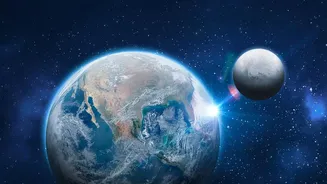
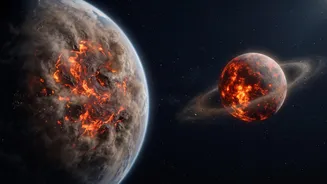
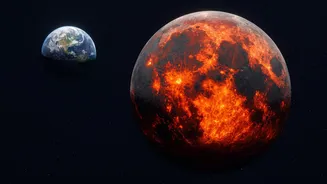
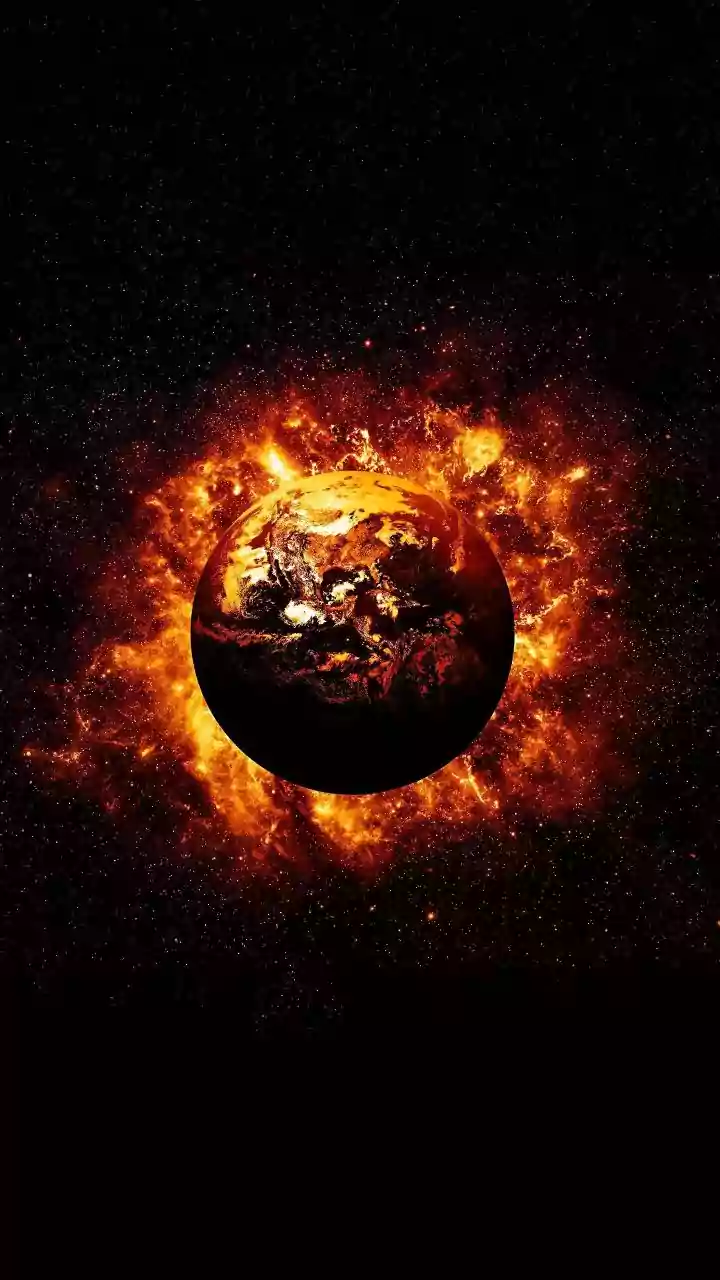
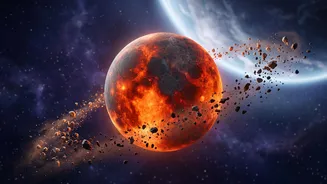
The most widely accepted explanation for the Moon's origin has long been the Giant-Impact Hypothesis. The story goes that about 4.5 billion years ago, when our solar system was a chaotic construction site, a Mars-sized planet named Theia slammed into
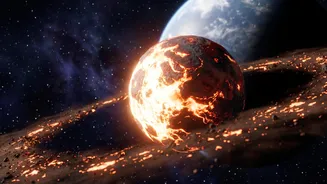
the still-forming Earth. This cataclysmic collision launched a massive ring of molten rock and vaporized debris into orbit. For decades, scientists believed this debris disk then slowly, over thousands or even millions of years, clumped together through gravity to form the Moon. This "long debris-disk route" explained key features, like the Moon's smaller iron core and evidence that it was once covered in a magma ocean.
A Lingering Chemical Mystery
Despite its strengths, the classic impact theory had a persistent problem: the Moon and Earth are too much alike. Analysis of rock samples brought back by the Apollo missions showed that the Earth and Moon have nearly identical isotopic signatures for elements like oxygen and titanium. Isotopes are like a material's birth certificate, and bodies formed in different parts of the solar system typically have distinct signatures. If the Moon was mostly formed from the remains of Theia, as the slow-accretion model suggested, it should have a different isotopic makeup than Earth. This uncanny similarity, known as the "isotopic crisis," has puzzled scientists, forcing them to either assume Theia was an unlikely twin of Earth or find a formation mechanism that allowed for extreme mixing of material.
A Faster, More Violent Beginning
Recent supercomputer simulations are now offering a dramatic solution to this puzzle. By creating higher-resolution models that account for factors like the temperature and material strength of the colliding planets, scientists have uncovered a new, much faster possibility. Instead of a debris disk that takes ages to coalesce, some of these new simulations show the giant impact could have launched a large, nearly intact Moon-sized body directly into a stable orbit within a matter of hours. In one model, a recognizable proto-Moon emerged in about five hours. This "immediate-satellite scenario" avoids the long, slow process of accretion entirely.
Why A Speedy Birth Makes More Sense
A rapid formation event provides a much cleaner explanation for the Earth-Moon isotopic similarity. If the Moon formed immediately from a mix of vaporized rock from both Earth's mantle and the shattered impactor, it would naturally share Earth's chemical fingerprint. The extreme energies of the collision would have created a thoroughly blended cloud of material from which the Moon could condense quickly, before different elements had time to separate. This immediate formation model helps resolve the major flaw in the long debris-disk theory. Researchers emphasize that this is a simulation-based pathway, and work continues to determine which scenario best fits all the available evidence, from lunar rock composition to the Moon's orbit.