




The Sugar of Life
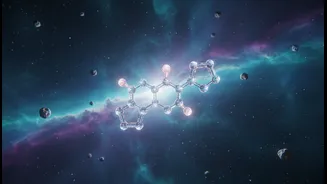
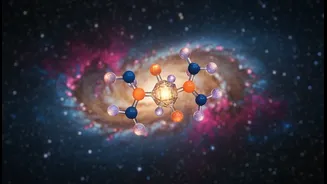
When scientists talk about "cosmic sugar," they aren't referring to the type you stir into your morning tea. They're talking about molecules like ribose, a five-carbon sugar that is a fundamental building block of RNA (ribonucleic acid). In modern life,
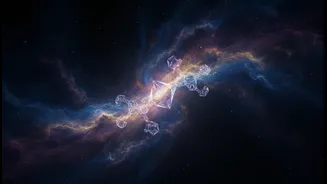
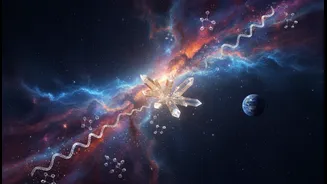
DNA holds the genetic blueprint, but many scientists support the "RNA World" hypothesis. This theory suggests that before DNA evolved, RNA played the dual role of both storing genetic information and catalysing the chemical reactions necessary for life. Finding a source for a steady supply of ribose on a sterile, prebiotic Earth has been a major challenge for origin-of-life theories. Early Earth's environment was likely not efficient at producing these complex molecules. This is why the discovery of these sugars in space is so significant; it provides a potential answer to where these vital ingredients came from.
A Special Delivery From The Cosmos
The delivery mechanism for this cosmic sugar is thought to be meteorites and comets. For decades, scientists have found other building blocks of life, like amino acids (the components of proteins) and nucleobases (the components of DNA and RNA), inside meteorites that have crashed into Earth. More recently, researchers have confirmed the presence of extraterrestrial ribose and other essential sugars in several carbonaceous chondrites, a type of primitive meteorite. To prove these sugars weren't just contamination from Earth, scientists analyzed their carbon isotopes. The sugars in the meteorites were enriched with a heavier type of carbon, carbon-13, which is more common in molecules formed in space than on Earth, confirming their extraterrestrial origin. Pristine samples returned directly from asteroids like Bennu and Ryugu have further solidified this evidence, showing that these molecules exist in a clean, non-terrestrial environment.
Calculating The Cosmic Downpour
The headline-making figure of "millions of tonnes" comes from recent discoveries and subsequent calculations. In July 2026, a study published in Nature Astronomy detailed the first-ever detection of a true sugar, called erythrulose, in a molecular cloud near the center of our galaxy. By measuring the abundance of this sugar in the vast interstellar cloud, a region where stars and planets are born, researchers could estimate how much of it might have been incorporated into the asteroids and comets that formed our solar system. Based on these measurements, scientists calculated that anywhere from 0.5 to 50 million tonnes of this sugar could have been delivered to Earth during the "Late Heavy Bombardment," a period of intense asteroid impacts around 4 billion years ago. This provides a plausible pathway for Earth to have acquired a vast reservoir of prebiotic ingredients from space.
Fueling the Panspermia Hypothesis
This growing body of evidence lends strong support to a version of the panspermia hypothesis. While the most extreme version of this idea suggests that actual microbial life travels between planets, a more moderate and widely considered version, sometimes called pseudo-panspermia, proposes that it's the chemical precursors to life that are distributed throughout the universe. The discovery of sugars, amino acids, and nucleobases in meteorites and interstellar clouds shows that the fundamental ingredients for biology can form naturally in space, without life itself being present. These molecules could then seed sterile planets like the young Earth, providing the raw materials needed for abiogenesis—the process by which life arises from non-living matter. It doesn't mean life came from space, but that its essential starter kit did.
What This Means For the Search for Life
The confirmation that essential sugars form in interstellar space and are delivered by asteroids has profound implications. It suggests that the building blocks of life are not a unique feature of Earth but are likely common throughout the galaxy. If the ingredients are everywhere, then it raises the probability that life could have started on other worlds in a similar way. The research doesn't prove that extraterrestrial sugars directly led to life on Earth, as the journey from simple molecules to a living cell is still a colossal and mysterious leap. However, it solves a crucial piece of the puzzle by providing a scientifically supported source for the raw materials. Future research will focus on analyzing more meteorite and asteroid samples to understand the variety and quantity of these cosmic molecules, giving us a clearer picture of the sweet, cosmic origins of us all.