




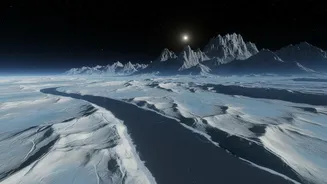
The Beating Heart of Pluto
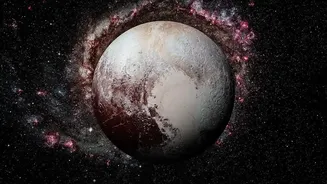
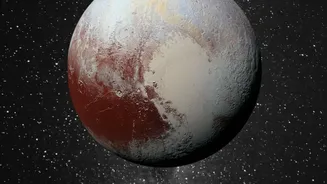
The key to understanding Pluto's activity lies in a vast, heart-shaped basin on its surface called Sputnik Planitia. This enormous feature, larger than Texas and Oklahoma combined, is not solid rock but a massive glacier made primarily of frozen nitrogen.
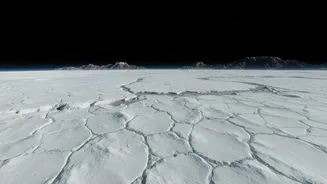
For years, scientists were baffled by this region, which shows no impact craters, suggesting its surface is constantly being renewed. This lack of scarring means the terrain is geologically young, with some estimates putting its age at less than a million years. The surface is covered in city-sized polygonal cells, evidence of slow, churning movement from within, much like a cosmic lava lamp. This constant overturning is the “strange movement” that has intrigued scientists since NASA's New Horizons spacecraft flew by in 2015.
A Nitrogen-Powered Engine
How can a world so far from the Sun, where surface temperatures plummet to -240°C, have such vigorous geological activity? The answer is nitrogen's unique properties. While the sunlight reaching Pluto is about 1,600 times fainter than on Earth, it's just enough to power a process called sublimation. This process turns the solid nitrogen ice directly into gas, which then cools the surface of the glacier. This temperature difference between the top and the warmer bottom—heated by Pluto's faint internal heat—drives a slow but powerful convection cycle. Chunks of solid nitrogen slowly rise and fall, churning the surface and erasing any craters over time. This process is similar to what happens in a pot of boiling water, just unimaginably slower and colder.
Cracks in the Icy Foundation
The latest piece of the puzzle, revealed by a new analysis of New Horizons data, involves what lies beneath the nitrogen glacier. Researchers discovered dark streaks and patches along the edges of the convection cells that look remarkably similar to features on Earth's glaciers where water has welled up from below. Since liquid nitrogen rain is impossible on Pluto, scientists concluded the liquid must be coming from underneath. Computer models show that pressure at the base of the kilometers-deep glacier can melt the nitrogen ice, creating reservoirs of liquid nitrogen. This less-dense liquid then forces its way up through cracks and fractures in Pluto's crust of water ice, which acts as a brittle bedrock beneath the softer nitrogen glacier.
A World Reshaped from Within
When this liquid nitrogen erupts onto the surface, it spreads out and refreezes, darkening the ice and creating the distinct patterns seen by New Horizons. This process suggests that Pluto has recently, and may still have, active liquid flows on its surface—a stunning revelation for such a cold body. The immense pressure from the moving glaciers also puts stress on the underlying water-ice crust, creating vast networks of faults and canyons. Some scientists also believe this internal heat and pressure has fuelled cryovolcanoes, or “ice volcanoes,” which erupt a slushy mix of water, ammonia, and other ices instead of molten rock. Features like the massive Wright Mons and Piccard Mons, towering mountains with large central depressions, are prime candidates for these exotic volcanoes.