

A Hidden Danger in Zero Gravity
For decades, astronauts have returned from missions reporting changes to their eyesight. Some experience blurry vision, while others have trouble focusing. The phenomenon is now understood as a medical condition called Space-Associated Neuro-ocular Syndrome,
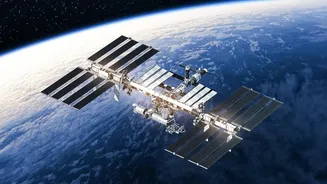
or SANS. It affects a striking number of spacefarers, with some studies showing that approximately 70 percent of astronauts on long missions aboard the International Space Station experience some degree of its effects. The root cause appears to be microgravity itself. On Earth, gravity pulls our bodily fluids down. In space, that pull is gone, and fluids shift toward the head, increasing pressure on the brain and the back of the eyes. This can lead to swelling of the optic nerve, a flattening of the eyeball’s shape, and folds in the retina. While some symptoms may resolve after returning to Earth, others can persist for years, posing a significant risk for missions that could last two to three years, like a round trip to Mars.
An AI Doctor for the Final Frontier
To solve this problem, space agencies and researchers are turning to artificial intelligence. The “automated retina scanner” isn't one single device, but rather a new approach that combines high-resolution eye imaging with sophisticated AI models. Teams at institutions like the University of California San Diego, with support from NASA, are developing deep learning algorithms to analyze these scans. The primary imaging technology used is Optical Coherence Tomography (OCT), which acts like an ultrasound for the eye, creating incredibly detailed, cross-sectional images of the retina and optic nerve. These AI models are trained on thousands of images, learning to spot the subtle, microscopic changes that signal the onset of SANS. The European Space Agency has a similar program, called Retinal Diagnostics, which uses a special lens attached to a tablet to capture eye images on the space station and feed them into an AI database for analysis.
From In-Flight Diagnosis to Pre-Flight Prediction
The true breakthrough of this technology isn’t just its ability to monitor astronauts in space; it's the power of prediction. By training AI on data from astronauts before and after their flights, as well as data from Earth-based simulations that mimic weightlessness, researchers have built models that can forecast an individual’s risk of developing SANS before they even leave the planet. The model developed at UC San Diego has shown a promising accuracy rate of up to 82 percent in predicting which astronauts are most susceptible. This capability is a game-changer for mission planning. Agencies could select crew members who are less genetically or physiologically predisposed to the condition. It also allows for the proactive development of countermeasures, from nutritional supplements to specialized equipment designed to pull fluid away from the head, personally tailored to those who need them most.
Cutting the Cord to Mission Control
For missions to the Moon or a space station in low-Earth orbit, astronauts have a relatively direct line to doctors on the ground. A medical question can be answered in seconds. But a trip to Mars is a different story. Depending on the alignment of the planets, a message sent from Mars could take more than 20 minutes to reach Earth, making real-time consultation impossible. This is why crew autonomy is one of NASA's highest priorities. An automated, AI-powered diagnostic tool can provide instant analysis without needing a team of specialists back on Earth to review the data. The system can alert the crew’s medical officer to a potential issue long before it becomes mission-critical. While researchers note the technology is still in development and not yet ready for full clinical use, it represents a foundational step toward the independent healthcare systems that will be essential for keeping humans safe as they venture farther from home than ever before.