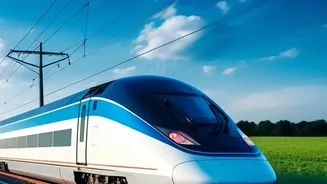








Mapping the Ambitious Northern Route
The proposed northern bullet train network is a grand vision for connectivity across several states. At its core are key high-speed arteries, with the Delhi-Varanasi line forming a significant segment. The broader plan, approved by the Prime Minister
in late 2026, envisions a corridor extending from Delhi to Guwahati. This sprawling network would pass through some of India's most populous and economically significant cities, including Agra, Kanpur, Lucknow, Ayodhya, and Patna, before heading east through Siliguri. The project is being developed by the National High Speed Rail Corporation Limited (NHSRCL), the same body implementing the Mumbai-Ahmedabad corridor. The plan is to tackle this massive undertaking in phases, with the Delhi-Varanasi section marked as a priority.
A Revolution in Travel Time
The most dramatic impact of the northern corridor will be the radical reduction in travel times. Projections suggest a journey from Delhi to Agra could be completed in just 59 minutes, while the trip to Lucknow could take around 2 hours and 12 minutes. The full journey from Delhi to the spiritual city of Varanasi is expected to be cut to approximately 3 hours and 33 minutes, a significant improvement over the 8-plus hours it can take on even the fastest current trains. Further east, the proposed connection from Varanasi to Patna could take about an hour. These corridors are being designed for operational speeds of around 320 km/h, bringing major commercial, religious, and tourism hubs within easy reach of each other.
Current Status: From Proposal to Plan
While the northern corridor has received high-level approval, it remains in the planning and design phase. The National High Speed Rail Corporation Limited (NHSRCL) has submitted the Detailed Project Report (DPR) for the Delhi-Varanasi-Patna-Siliguri corridor to the Ministry of Railways for review. This report outlines the technical specifications, alignment, and station locations. Following ministry finalisation, the DPR will proceed to the Union Cabinet for ultimate approval. Survey work, including advanced aerial LiDAR surveys to map the precise alignment, has been progressing to lay the groundwork for land acquisition and construction. However, a definitive construction start date and final project costs have not yet been announced.
Building on Experience and 'Make in India'
The development of the northern corridor will benefit immensely from the experience gained during the construction of the Mumbai-Ahmedabad line. Officials have emphasised a focus on standardising designs for infrastructure like piers and girders to fast-track future projects. A key goal for these new corridors is a significant push towards self-reliance under the 'Make in India' initiative. While the first bullet train project involves extensive collaboration with Japan, the government has stated its intention to use more indigenous technology and manufacturing for the subsequent seven proposed high-speed corridors, including the northern route. This includes developing local capabilities in everything from civil engineering and signalling to the manufacturing of the high-speed trainsets themselves.
Part of a National High-Speed Vision
The northern corridor is a crucial component of a much larger national strategy known as the Diamond Quadrilateral. This long-term plan aims to connect India's four major metropolitan centres—Delhi, Mumbai, Chennai, and Kolkata—with a network of high-speed rail lines. The National Rail Plan outlines a vision to create a modern, high-capacity passenger network that shifts travellers from congested roads and airways to more sustainable rail transport. The Delhi-Varanasi and Varanasi-Siliguri sections fit directly into this national grid. By linking major economic zones, these corridors are expected to not only enhance passenger mobility but also stimulate regional development, trade, and tourism across the country.