




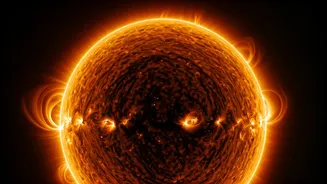


What a 'Quiet' Sun Actually Means
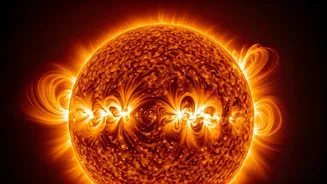
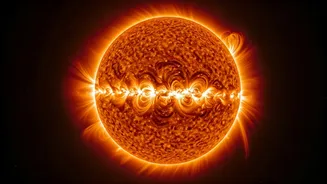
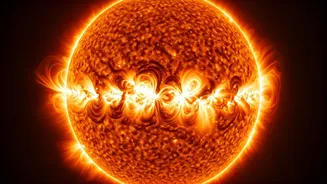
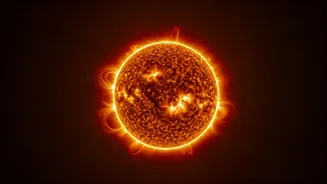
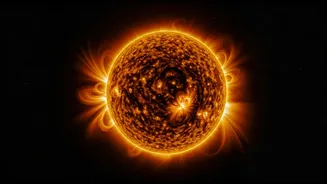
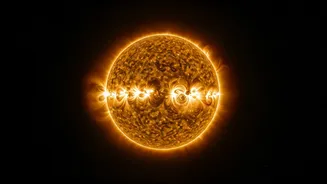
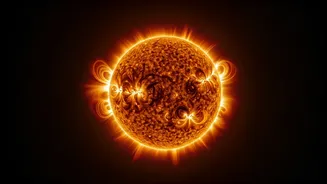
When scientists talk about the sun 'quieting down,' they aren't suggesting it will turn off. Instead, they are referring to a potential extended period of low solar activity. The sun normally goes through an 11-year cycle of activity, moving between a solar maximum
(lots of sunspots, flares, and eruptions) and a solar minimum (fewer of these events). A 'quiet' period would be like a solar minimum that lasts for decades, an event known as a 'grand solar minimum'. During such times, the sun's magnetic field weakens, and its energy output can decrease slightly.
A Look Back at the 'Little Ice Age'
History gives us a prime example of what this could look like. Between roughly 1645 and 1715, the sun went through a prolonged quiet period called the Maunder Minimum. During this 70-year span, sunspots became exceptionally rare. This period coincided with the middle part of the 'Little Ice Age' in the Northern Hemisphere, a time of bitterly cold winters. Rivers that rarely freeze, like London's Thames, were regularly covered in thick ice. While the link is compelling, scientists are cautious. The Little Ice Age started before the Maunder Minimum and was likely influenced by other factors too, such as major volcanic eruptions.
Is Our Sun Quieting Now?
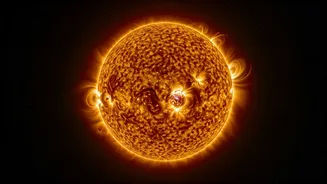
This question is at the heart of the current scientific discussion. Solar Cycle 24, which ended in December 2019, was the weakest in over a century. This led some researchers to speculate that we might be heading towards another grand minimum. However, the current cycle, Solar Cycle 25, has defied those expectations. It has been significantly more active than initially predicted, roaring to life faster and stronger than its predecessor. As of mid-2026, the sun is in an active phase, with frequent flares. This contradicts the idea of an imminent and sudden quiet period, though scientists note that solar activity has been on a general declining trend since the 1960s.
The Great Scientific Debate
Predicting the sun's long-term behavior is incredibly difficult. One group of scientists, pointing to long-term cycles and trends, suggests that a grand solar minimum in the coming decades, perhaps around 2030-2040, is possible or even likely. They argue that the weaker cycles are a sign of a larger pattern. On the other hand, many solar physicists maintain that there is no strong evidence to suggest we are entering a Maunder-like minimum. They point out that Solar Cycle 25's current strength shows that the sun's regular 11-year cycle is still very much in effect, and that a single weak cycle does not necessarily signal a long-term shutdown.
What Would It Mean for Earth?
If a grand solar minimum did occur, the effects would be noticeable but not catastrophic. The most-cited effect is a slight global cooling. However, this cooling would be minor, estimated at a reduction of perhaps 0.1 to 0.3 degrees Celsius. This is nowhere near enough to offset the warming caused by human-generated greenhouse gases. NASA states that the warming from emissions is six times greater than the potential cooling from a prolonged solar minimum. So, it would not trigger an ice age. Other potential effects include changes to regional weather patterns and an increase in cosmic rays entering our atmosphere, as the sun's weaker magnetic field would offer less protection.