

A Cosmic Lion's Roar
Located about 6,500 light-years away in the constellation Gemini, NGC 2392 is what astronomers call a planetary nebula. The name is a historical holdover; these objects have nothing to do with planets but appeared as round, planet-like discs to early
astronomers like William Herschel, who discovered this one in 1787. In reality, it is the glowing, expanding shell of gas and dust cast off by a dying star. This particular nebula has earned nicknames like the Lion Nebula and the Clown-Faced Nebula due to its remarkable structure, which resembles a face surrounded by a thick mane or parka hood. At its heart sits the hot, dense remnant of the original star—a white dwarf—that is now furiously illuminating and sculpting the material it previously ejected.
Webb's Infrared Advantage
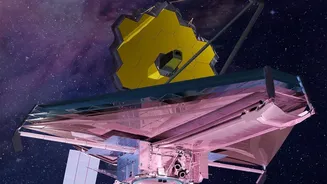
While the Hubble Space Telescope gave us remarkable views of NGC 2392 in visible light, Webb’s power lies in its ability to see the universe in infrared. Using its Near-Infrared Camera (NIRCam) and Mid-Infrared Instrument (MIRI), Webb can peer through the obscuring haze and capture the intricate behaviour of dust and gas. This new composite image, combining data from both instruments, highlights features that were previously difficult to parse. It reveals a complex interior bubble of ionized gas, shaped by the intense radiation from the central star, surrounded by an outer 'mane' filled with complex dusty structures. This infrared view allows scientists to better distinguish between the hot gas and the cooler, denser dust, providing a clearer picture of the nebula's anatomy.
The Story Told in Dust and Gas
The details revealed by Webb are more than just beautiful—they tell a story of cosmic violence and survival. The central star is so hot that its radiation is destroying much of the dust in its immediate vicinity, carving out the inner 'face' of the lion. However, the image also shows dense clumps of dust that have managed to survive this onslaught. These clumps, appearing like fluffy tufts in a mane or comet-like objects with tails, are dense enough to shield the material behind them from the star's destructive radiation. The structure is the result of a two-stage process: a slower wind from the star as it aged, followed by a much faster wind from the exposed hot core, which slammed into the older material and created the complex shells we see today.
A Glimpse of Our Sun's Distant Future
Studying planetary nebulae like NGC 2392 is not just an academic exercise; it provides a preview of our own solar system's ultimate fate. In about five billion years, our Sun will exhaust its nuclear fuel and go through a similar process. It will swell into a red giant before shedding its outer layers to form its own planetary nebula, leaving behind a white dwarf. By analyzing the intricate structures and chemical composition of objects like the Lion Nebula, astronomers can refine their models of stellar evolution for the vast majority of stars in the universe—those with lower masses, like our Sun. Though Webb's image seems to freeze this moment in time, the nebula is a dynamic, evolving object. Astronomers estimate that in another 10,000 years or so—a blink of an eye in cosmic terms—the magnificent lion will have dispersed completely into interstellar space.