





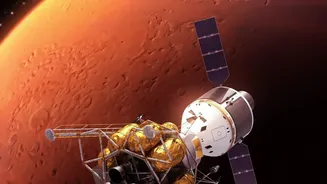

A Planet of Wild Weather
Understanding the weather on Mars is one of the biggest challenges for space exploration. Before we can safely land rovers, build habitats, or send astronauts, we need to know what we are getting into. The Red Planet’s thin atmosphere means it cannot
hold onto heat like Earth’s does. As a result, the surface experiences brutal temperature swings. Recent research from Indian scientists has precisely mapped these variations, recording summer highs of a surprisingly mild 27 degrees Celsius and winter lows plunging to a staggering minus 113 degrees Celsius. These extremes are driven not just by seasons, but by Mars' elliptical orbit, which makes the southern summers particularly harsh. Navigating these conditions is critical, as sudden changes can affect a spacecraft’s descent and the long-term survival of equipment on the surface.
Decoding the Zonal Waves
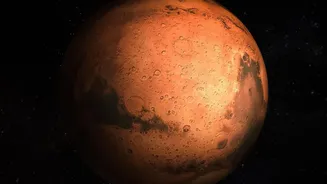
Beyond the dramatic temperature shifts, the new study reveals that heat doesn't just appear and disappear—it moves across the planet in massive, structured patterns known as zonal waves. Think of them as ripples in the atmosphere, providing an indirect clue to how the planet's climate system circulates. Scientists from the Physical Research Laboratory (PRL) in Ahmedabad, using data from the Emirates Mars Mission's Hope spacecraft, focused on two of Mars' largest impact basins, Hellas and Argyre. They found a striking difference between them. The Argyre basin was dominated by a large-scale, single-wave pattern, while the Hellas basin showed more complex two- and three-wave patterns that changed with the seasons. This discovery confirms that Mars' topography—its vast basins, canyons, and mountains—plays a fundamental role in shaping its weather, dictating how and where heat is distributed across the planet.
Building on the Legacy of Mangalyaan
This latest breakthrough is part of a larger story about India's growing expertise in planetary science, a journey accelerated by the historic Mars Orbiter Mission (MOM), or Mangalyaan. Launched in 2013, Mangalyaan made India the first nation to reach Martian orbit on its first attempt, a source of immense national pride. For over seven years, its five scientific instruments provided invaluable data on the Martian atmosphere, mineralogy, and surface, studying everything from the potential presence of methane to how the planet lost its water over aeons. Instruments like the Thermal Infrared Imaging Spectrometer (TIS) were designed specifically to map surface temperatures. Though this new research uses data from a different mission, the foundational knowledge and expertise built during the Mangalyaan years were crucial in enabling Indian scientists to ask these sophisticated questions and interpret the complex data.
Paving the Way for Mangalyaan-2
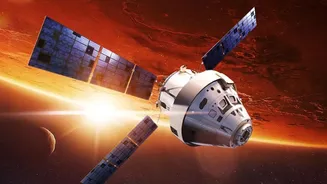
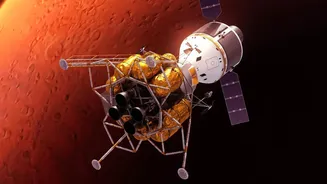
This detailed understanding of the Martian climate is not just an academic exercise; it is essential for planning future missions. Every piece of data on atmospheric density, wind patterns, and temperature extremes directly informs the design of the next generation of landers and rovers. ISRO is already planning its ambitious successor mission, Mangalyaan-2, which aims to be India's first attempt to land on the Martian surface. Scheduled for a launch around 2030, the mission is expected to include not just an orbiter but also a lander and potentially a rover and even a small helicopter. Success would place India in an elite group of nations that have operated vehicles on another planet. The fresh insights into Mars' climate provided by PRL scientists will be vital for engineering the complex entry, descent, and landing systems needed to survive the planet's thin, unpredictable atmosphere and ensure Mangalyaan-2's success.