





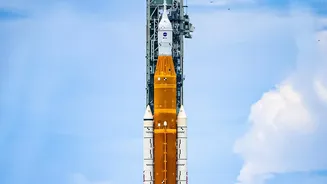
The Trouble With Rockets
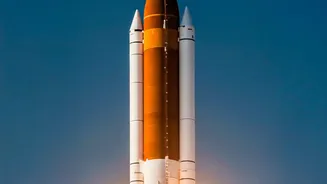
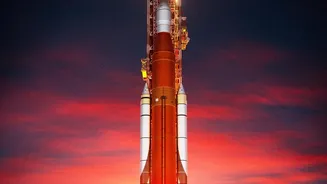
Traditional rockets are marvels of engineering, but they are fundamentally inefficient. Most of a rocket's mass at liftoff is just fuel needed to lift more fuel, all while fighting Earth's gravity and thick lower atmosphere. This reality, governed by
what's known as the rocket equation, makes space launch incredibly expensive. A Falcon 9 launch, for instance, costs roughly $3,000 per kilogram sent to low Earth orbit. This high cost is a major barrier, limiting how often we can launch satellites for communications, research, and navigation. Longshot Space argues that to truly open up access to orbit, we need to leave the most fuel-intensive part of the journey on the ground.
Meet the Space Gun
Longshot's solution is a kinetic launch system—essentially, a massive gun that uses compressed gas to accelerate a payload to hypersonic speeds. The concept itself isn't entirely new, drawing inspiration from historical projects like the V-3, a World War II-era supergun designed to bombard London from across the English Channel. While that weapon never worked properly, Longshot is reviving the core physics with modern technology. The idea is to use an enormous ground-based accelerator to provide the initial, powerful push, getting a payload most of the way out of the atmosphere before a small, secondary propulsion system takes over for the final push into orbit.
How It Actually Works
Instead of a single explosive charge, Longshot's system uses a technique called “multi-injection.” As a projectile carrying a satellite travels down a very long tube, precisely timed bursts of compressed gas are injected through ports along the barrel. Each burst adds another kick of acceleration. The key technical challenge was timing these injections with sub-millisecond precision, a problem the company solved by designing its own custom-built light gates and electrically actuated burst discs. So far, the company's 70-foot prototype in Oakland, California, has successfully accelerated payloads past Mach 4. The goal is to reach Mach 25 for orbital launches, which will require a much larger system.
The Business of Hypersonics
Building a cannon that's miles long is a huge undertaking. To generate revenue and prove its technology along the way, Longshot has a clever intermediate step: hypersonic testing. The U.S. military and defense contractors spend millions—between $6 million and $8 million per test—to study how materials and components behave at speeds above Mach 5. Longshot believes it can offer the same service for as little as $150,000. By providing a cheaper, more frequent way to conduct these tests, the company can build a viable business while scaling up its technology. It has already secured funding from investors like Sam Altman and Draper Associates, as well as grants from the U.S. Air Force.
Challenges and the Path Forward
The primary challenge for any kinetic launch system is the immense force of acceleration. Longshot's CEO Mike Grace argues that a longer accelerator makes the launch gentler, but payloads must still be incredibly robust to survive. The company's answer is a specialized projectile, including a hypersonic glide vehicle called Glowrider, designed to survive transit through the lower atmosphere. With around $20 million in total funding secured, Longshot is now building its next-generation launchers at a test site in Nevada. The ultimate vision is a launch facility with a cannon up to 12 miles long, potentially in a remote location like northern Australia, capable of putting 100-kilogram payloads into orbit for as little as $150 per kilogram—a price that could fundamentally change our relationship with space.