







A First-in-the-Nation Pause
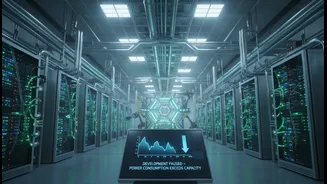
New York has become the first US state to halt the development of new, large-scale data centers. On July 14, 2026, Governor Kathy Hochul signed an executive order pausing state environmental permits for new "hyperscale" data centers for up to one year.
Her reasoning was direct: to prevent the immense energy needs of these facilities from driving up electricity bills for ordinary residents and businesses. "As data center development threatens to hike up utility bills, deplete our natural resources, and create uncertainty for New Yorkers, it's my responsibility to take action and lead," Hochul stated. The moratorium applies to data centers that consume over 50 megawatts of power, targeting the massive facilities required for advanced AI. During this pause, state agencies are tasked with creating a new regulatory framework to manage how these tech giants impact the state's power grid and its citizens' wallets.
The Soaring Energy Cost of AI
To understand the debate, one must grasp the sheer scale of energy that AI consumes. Globally, data centers already accounted for about 1.5% of all electricity consumption in 2024, a figure projected to double by 2030. AI-specific servers are the main driver of this growth. A single ChatGPT query, for instance, is estimated to use nearly ten times more power than a standard Google search. This staggering demand puts immense strain on electrical grids that were not designed for such concentrated loads. Building the new power plants and transmission lines required can take years, whereas a data center can be built in 12 months or less. This mismatch creates a critical question: when a utility company has to spend billions on upgrades to serve a handful of new, power-hungry customers, who should foot the bill?
The Ratepayer's Dilemma
Historically, the costs for major utility infrastructure upgrades are often socialized, meaning they are spread across all customers in the form of higher rates. This is the core of the issue Hochul and other leaders are confronting. While tech companies pay for their direct power usage, the broader grid improvements they necessitate often fall on the public. Critics of this model argue that residential customers and small businesses are effectively subsidizing the infrastructure for some of the world's wealthiest corporations. Governor Hochul's plan aims to reverse this by requiring data centers to either pay more for their energy, supply their own power, or contribute to a new "Grid Acceleration Fund" to help finance the upgrades they require. The state is also moving to repeal sales tax exemptions previously granted to these large data centers.
A Global Debate with Indian Resonance
While this drama is unfolding in New York, its implications are global. The debate over who pays for AI's energy thirst is not unique to the United States. India, with its own booming digital economy and rapidly growing data center market, faces the same fundamental challenge. Projections show that electricity demand from data centers in India could more than double by 2030. Several Indian states, including Gujarat, Tamil Nadu, and Telangana, have already created policies to attract data center investment, often including incentives like subsidized electricity. However, as the energy demands of AI become clearer, the precedent set in New York could influence future policy discussions in India and worldwide. The central question remains universal: how can governments foster technological innovation without placing an unfair financial burden on the public? Governor Hochul's move signals a potential shift, where tech companies may increasingly be asked to pay the full price of their power-intensive ambitions.