




A Partnership Forged for the Final Frontier
To achieve its ambitious goals under the Artemis program, NASA needs expertise in areas beyond rocketry and space exploration. This is where its long-standing collaboration with the U.S. Department of Energy becomes critical. A recently renewed Memorandum
of Understanding solidifies their joint effort to develop space-ready nuclear technologies. This partnership combines NASA's mastery of space missions with the DOE's deep knowledge of nuclear reactor design, fuel, and safety. The collaboration isn't new, with roots stretching back decades, but it has gained significant momentum with the goal of establishing a sustained human presence on the Moon and eventually Mars. The agencies are working together on everything from initial research and fuel production to testing and eventual mission integration, with an uncompromising commitment to safety at every step.
Why the Moon Needs Nuclear Power
For short-term missions, solar power has been a reliable workhorse. But for a permanent lunar base, it has a significant drawback: the Moon's long day-night cycle. A lunar night lasts for 14 Earth days, a period of extreme cold and total darkness where solar panels are useless. While using massive batteries to store solar energy is theoretically possible, the weight and scale required make it impractical to launch from Earth. Nuclear fission, on the other hand, offers a continuous, reliable, and powerful energy source, regardless of sunlight. A small, lightweight nuclear reactor could provide the tens of kilowatts needed to run habitats, life support, science experiments, and rovers for a decade or more without refueling. This makes it an essential enabling technology for turning a temporary outpost into a true lunar base camp.
Introducing Fission Surface Power
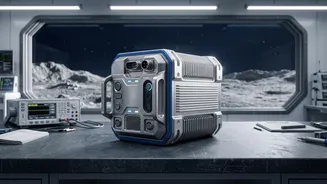
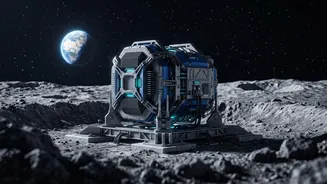
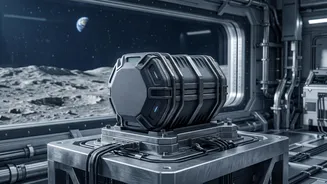
The centerpiece of this effort is the Fission Surface Power (FSP) project. Building on the success of the earlier Kilopower project, which demonstrated a prototype reactor in 2018, the FSP aims to deliver a flight-ready system to the Moon. The goal is to deploy a reactor capable of generating at least 40 kilowatts of electrical power—enough to power about 30 households—continuously for 10 years. The basic design involves a small, solid uranium reactor core about the size of a paper towel roll. Heat generated by fission is transferred via passive heat pipes to Stirling engines, which then convert that thermal energy into electricity. NASA and the DOE have selected multiple industry partners to develop competing design concepts, with the aim of having a system ready for a lunar demonstration by the early 2030s.
The Core Research Challenges
Putting a nuclear reactor on the Moon is a monumental engineering task with unique challenges not faced on Earth. First, the reactor must be small and light enough to be transported by rocket. Once there, it must operate with minimal to no human maintenance in an extreme environment. The system has to withstand the vacuum of space, micrometeoroid impacts, and punishing temperature swings. Another major hurdle is heat dissipation. Without air or water for cooling, the reactor will rely on large radiator panels to shed waste heat into space. The abrasive, electrically charged lunar dust, known as regolith, also poses a threat, as it can damage components. Finally, the entire system must be designed for autonomous and failsafe operation, ensuring it can shut down safely without human intervention.
Beyond the Moon to Mars
The Fission Surface Power project is not just about the Moon; it's a critical stepping stone for the human exploration of Mars. On Mars, solar power is even less effective, as the planet is farther from the Sun and experiences massive dust storms that can block sunlight for weeks. A robust and reliable nuclear power source is considered essential for supporting a crewed mission and base on the Red Planet. The technology being developed for the lunar surface—from the compact reactor core to the resilient power conversion systems—is being designed with extensibility for future Mars missions in mind. Successfully operating a fission reactor on the Moon will provide invaluable data and operational experience, paving the way for humanity's next giant leap.