



The Sun's Temporary Tattoos
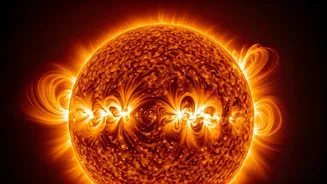
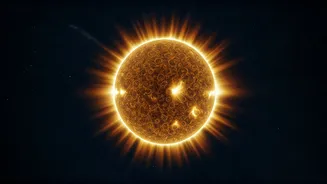
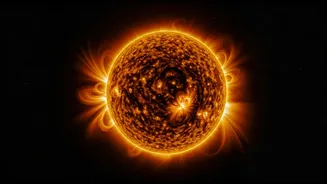
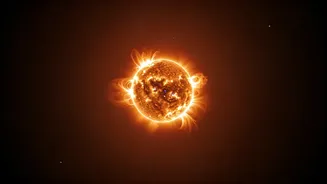
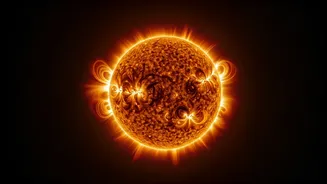
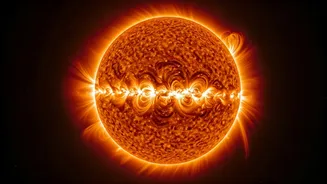
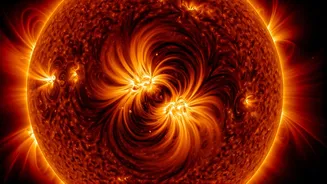
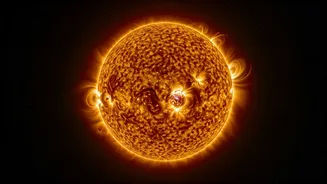
Those dark patches are known as sunspots. They aren't actually holes or permanent marks, but rather cooler, darker areas on the sun's visible surface, the photosphere. A sunspot is a region where the sun's powerful magnetic field becomes incredibly concentrated
and bursts through the surface. This intense magnetic activity inhibits the flow of hot gas from the sun's interior, making the spot appear darker because it's significantly cooler than its surroundings—though still blazingly hot by any Earthly standard. These spots can be enormous, some many times the size of our own planet, and they serve as the primary visual indicators of solar activity.
An 11-Year Cosmic Rhythm
The number of sunspots visible on the sun isn't constant; it ebbs and flows in a predictable rhythm known as the solar cycle, which lasts roughly 11 years. The cycle moves from a period of low activity, called the solar minimum when very few or no sunspots are visible, to a peak of high activity, the solar maximum, when hundreds can dot the sun's face. This cycle is a symptom of a much larger process: the sun's global magnetic field flipping its polarity. Every 11 years or so, the sun's magnetic north and south poles switch places. This process is messy, causing the magnetic fields to twist and erupt, which in turn drives the appearance of sunspots.
A March to the Equator
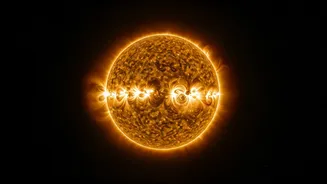
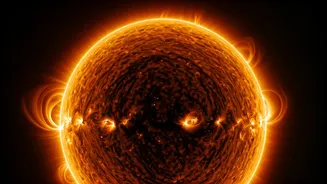
The location of these sunspots provides a crucial clue about where we are in the cycle. At the start of a new solar cycle, sunspots begin to appear at the sun's mid-latitudes, typically around 30 to 45 degrees north and south of the solar equator. As the cycle progresses over the years toward solar maximum, new sunspots form progressively closer and closer to the equator. By the time the cycle is winding down towards the next minimum, the last of the spots are appearing at very low latitudes, around 7 degrees. This predictable drift is known as Spörer's Law, named after the German astronomer Gustav Spörer who refined observations first made by Richard Carrington in the 19th century. When plotted on a graph of latitude versus time, this pattern creates a distinctive shape that looks like a pair of butterfly wings, earning it the name "butterfly diagram."
Why This Solar Dance Matters on Earth
This predictable cycle is more than just an astronomical curiosity; it has tangible effects on our planet. The solar maximum, with its abundance of sunspots, is also a time of heightened space weather. Sunspots are the sources of powerful solar flares and massive eruptions of solar material called coronal mass ejections (CMEs). When these eruptions are aimed at Earth, they can interact with our planet's magnetic field and atmosphere. The most beautiful result is the aurora, or the Northern and Southern Lights, which become more frequent and can be seen from lower latitudes during solar maximum. However, these geomagnetic storms can also pose a serious risk to our technology-dependent society, with the potential to disrupt radio communications, damage navigation satellites, and even cause widespread power outages by overloading electrical grids.
Solar Cycle 25: A Stronger-Than-Expected Peak
We are currently in Solar Cycle 25, which began in December 2019. Initial predictions suggested it would be a relatively weak cycle, similar to the previous one. However, solar activity has consistently and significantly surpassed those forecasts. As of mid-2026, the sun has been highly active, with the smoothed sunspot number having already peaked in late 2024 at a level higher than the entire previous cycle. This period of heightened activity has led to notable space weather events, including strong geomagnetic storms that produced spectacular auroras visible from unusually low latitudes. This reminds us that while we can predict the sun's general rhythm, our star still holds surprises.