





The Challenge with Sriharikota
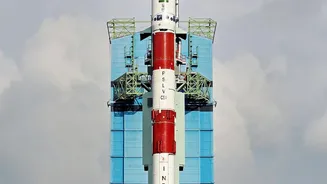
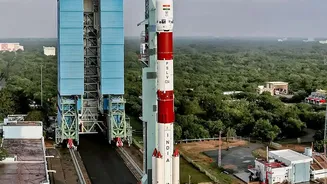
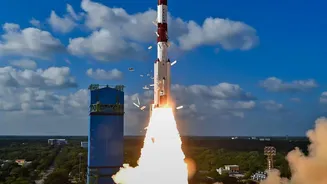
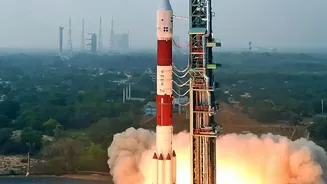
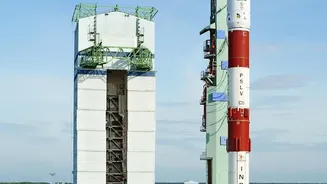
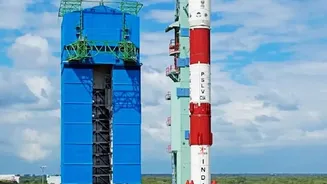
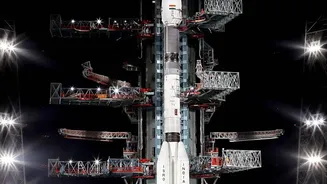
For decades, the Satish Dhawan Space Centre (SDSC) in Sriharikota, Andhra Pradesh, has been India's primary gateway to the cosmos. Its location on the east coast is ideal for most launches, which travel eastward to take advantage of Earth's rotational
speed. However, a geographical hurdle arises for missions heading south into a polar orbit. Directly south of Sriharikota lies the island nation of Sri Lanka. For safety reasons, rockets cannot fly over another country's landmass during the crucial launch phase. This forces ISRO's rockets to perform a complex and costly detour around Sri Lanka before aligning with their intended southward path.
The Costly 'Dogleg' Maneuver
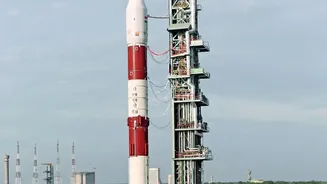
This detour is known in aerospace terminology as a "dogleg maneuver." It involves the rocket making a sharp turn mid-flight to change its trajectory. While larger, more powerful rockets like the PSLV and GSLV can perform this maneuver without a catastrophic loss of performance, it poses a significant problem for smaller launch vehicles. The Small Satellite Launch Vehicle (SSLV) is designed to be lean and efficient, catering to the booming global market for small satellite launches. For the SSLV, the extra fuel required to execute the dogleg maneuver severely penalizes its primary function: carrying a payload. The fuel spent on the turn eats directly into the rocket's capacity, making it less competitive.
A Straight Shot from Kulasekarapattinam
This is where the new spaceport at Kulasekarapattinam, located in Tamil Nadu's Thoothukudi district, changes the game. Its key advantage is its location. Positioned further south and west of Sriharikota, it offers a clear, direct, and unimpeded path for southward launches. Rockets taking off from Kulasekarapattinam can fly straight over the Indian Ocean without needing to perform the dogleg maneuver to avoid Sri Lanka. This direct trajectory is the 'more efficient flight path' that promises to unlock the full potential of the SSLV.
More Payload, Less Fuel
The benefits of this straight-line trajectory are substantial. By eliminating the fuel-guzzling dogleg maneuver, the SSLV can dedicate more of its power to its actual mission. This translates into a significant increase in payload capacity. While an SSLV launched from Sriharikota has an inadequate payload capacity for a useful mission to a Sun-Synchronous Polar Orbit (SSPO), the same rocket launching from Kulasekarapattinam can carry a payload of around 300 kg to the same orbit. This efficiency makes launches cheaper and allows India to carry heavier small satellites, or more of them, on a single mission, boosting its standing in the commercial launch market.
Built for the Small Satellite Boom
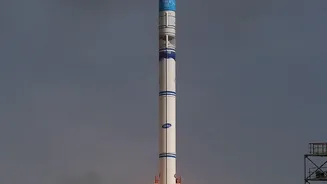
The Kulasekarapattinam facility is being developed specifically with the SSLV and other small launch vehicles in mind. The global demand for launching small satellites for communications, Earth observation, and reconnaissance is growing rapidly. The SSLV was created to provide on-demand, quick-turnaround launch services for this market. The new spaceport, with its geographical advantage and infrastructure designed for a higher launch frequency, is a perfect match for the SSLV's mission. This synergy will not only offload the busy schedule at Sriharikota, which will now focus on larger missions like Gaganyaan, but also create a dedicated hub for commercial space activities.
Powering India's Space Economy
The spaceport, a project costing nearly Rs 986 crore, is more than just a launch pad; it's a strategic investment in India's future space economy. The government is actively encouraging private sector participation, with plans to have private firms manage and operate the new launch complex. Proximity to ISRO's Propulsion Research Complex at Mahendragiri reduces logistics costs for transporting rocket components. Furthermore, the development is expected to spur the growth of a surrounding space industrial park, creating jobs and fostering an ecosystem of ancillary industries in the Thoothukudi region, from component fabrication to downstream data services. This positions Tamil Nadu to become a major hub in the global space industry.