





A Landmark Indian Discovery
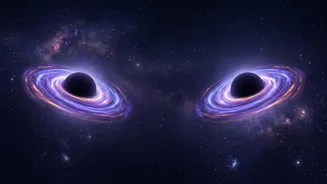
A team of researchers from the Indian Institute of Astrophysics (IIA) has announced the remarkable discovery of three supermassive black holes orbiting each other. This cosmic trio is located at the heart of a system of merging galaxies. The finding is exceptionally
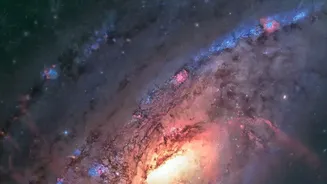
rare; only a handful of such triple systems have ever been confirmed. The team made the discovery while studying a known pair of interacting galaxies, NGC 7733 and NGC 7734. While observing the duo, they noticed that the center of one of the galaxies was behaving strangely, moving in a way that suggested it wasn't alone. This prompted a deeper investigation that revealed a hidden third galaxy, complete with its own supermassive black hole, creating what is known as a triple active galactic nucleus.
What Makes a Black Hole 'Active'?
Most large galaxies, including our own Milky Way, have a supermassive black hole at their core. Most of the time, these giants are dormant and relatively quiet. An 'active' black hole, however, is a different beast altogether. When a supermassive black hole is actively pulling in, or accreting, vast amounts of gas and dust from its surroundings, the material heats up to incredible temperatures and releases an immense amount of energy, causing the galaxy's core to shine brilliantly across the entire electromagnetic spectrum. This intensely bright region is called an Active Galactic Nucleus, or AGN. Such feeding frenzies are often triggered by galactic mergers, where the gravitational chaos funnels material towards the central black holes, effectively switching them 'on'.
The Galactic Detective Work
Confirming the presence of three active black holes required a multi-pronged approach, like cosmic detective work. The IIA team combined data from several of the world's most powerful observatories. They used India's own space observatory, AstroSat, to study the system's ultraviolet emissions. Further evidence came from the Very Large Telescope (VLT) in Chile, which provided detailed optical data helping to trace the motion of stars and gas. To get an even clearer picture, they incorporated radio observations from the MeerKAT telescope in South Africa. By piecing together the clues from these different wavelengths of light, the astronomers were able to confirm that all three galactic cores were indeed active and locked in a complex gravitational dance, on a collision course with each other.
Why This Triple System Matters
This discovery is more than just a cosmic curiosity; it offers a unique laboratory for understanding some of the universe's most extreme processes. Scientists believe that galaxies grow and evolve by merging with others. Observing a triple merger in action provides direct insight into how this fundamental process unfolds and how the supermassive black holes at their centres influence each other. Such systems are thought to be crucial for the formation of black hole binaries, which are two black holes in a close orbit. These binaries are expected to eventually merge, releasing powerful gravitational waves—ripples in spacetime—that we can potentially detect on Earth. Studying this triple system could therefore help scientists predict where to look for these waves and better understand the final stages of a galaxy merger.