





Why Sitting Wrecks Your Hips
Our bodies are designed for movement. When you sit for prolonged periods, your hips are held in a constant state of flexion. This causes the hip flexor muscles at the front of your body to become short and tight. Meanwhile, the gluteal muscles, which
are supposed to support your pelvis and stabilize your hips, become inactive and weak from lack of use. This muscular imbalance is a primary cause of the stiffness, discomfort, and reduced mobility many desk workers experience. Over time, this can lead to poor posture, lower back pain, and even an increased risk of injury as other parts of the body try to compensate.
The Importance of Hip Mobility
Good hip mobility is about more than just avoiding pain; it's fundamental to nearly every move you make. Your hips support your body's weight and are central to walking, climbing stairs, and even just standing up from your chair. When your hips can move through their full, intended range of motion, you place less strain on your lower back and knees. By actively working to counteract the effects of sitting, you can improve your posture, enhance athletic performance in your life outside of work, and significantly reduce your risk of developing chronic pain. Taking short, regular breaks for targeted stretches is a powerful way to keep these crucial joints healthy.
Seated Figure-Four Stretch
One of the most effective and discreet stretches you can do at your desk is the Figure-Four. Sit tall in your chair with both feet flat on the floor. Cross your right ankle over your left knee, creating a '4' shape with your legs. Keep your right foot flexed to protect your knee. You may already feel a stretch in your outer right hip. To deepen the stretch, gently press down on your right knee or hinge forward at your hips, keeping your back straight. Hold for 20-30 seconds, breathing deeply, then switch sides. This stretch targets the glutes and the piriformis, a small muscle deep in the buttocks that can contribute to hip tightness.
Chair-Assisted Hip Flexor Stretch
To combat those shortened hip flexors, you need to open the front of your hips. Stand up and turn to face away from your chair. Place your right foot on the seat of the chair behind you, with the top of your foot resting on the surface. Your left foot should be planted firmly on the ground in front, with your knee slightly bent. Stand tall and gently tuck your pelvis under until you feel a stretch in the front of your right hip and thigh. Avoid arching your back. If you need support, hold onto your desk. Hold for 20-30 seconds before carefully releasing and switching to the other leg.
Seated Pigeon Pose
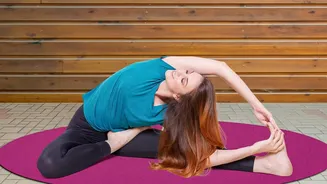
A modification of the classic yoga pose, the seated pigeon is excellent for opening the hips. While sitting at the edge of your chair, extend one leg straight out in front of you. Bend the other leg and bring the ankle to rest on the extended thigh. Gently lean forward over your bent leg, maintaining a straight spine, until you feel a comfortable stretch in your hip and glute. This stretch allows for a deep release without putting pressure on the knees. Remember to breathe throughout the stretch, holding for 30 seconds on each side.
Making It a Habit
The key to improving mobility and reducing stiffness is consistency. Simply performing one stretch a day won't be enough to undo hours of sitting. Try to incorporate these movements into your daily routine. Set a timer to remind yourself to stand up and stretch every hour. You could do the Figure-Four stretch every time you finish a long email, or the hip flexor stretch while you wait for a document to print. By linking these small movements to existing work habits, you are more likely to perform them consistently. Small, regular efforts are more effective than one intense session a week.