





Meet the 'Microblazar' Candidate
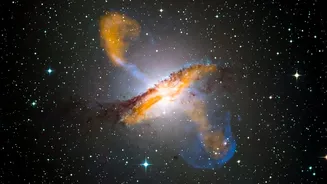
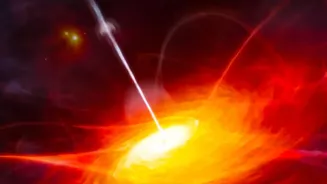
For decades, astronomers theorised about the existence of 'microblazars' in our own galaxy but had never definitively found one. A blazar is a hugely energetic object powered by a supermassive black hole at the centre of a distant galaxy, which blasts
out a jet of particles and radiation. Crucially, for it to be called a blazar, one of those jets has to be pointing directly at Earth. A microblazar is the same principle but on a much smaller scale: a stellar-mass black hole, just a few times the mass of our Sun, doing the same thing inside our own galaxy. Recently, an international team of scientists identified the strongest candidate yet for a microblazar: a system named IRAS 18293-0941, located about 12,000 light-years away.
A Black Hole and Its Giant Companion
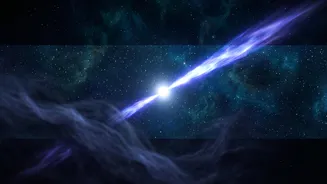
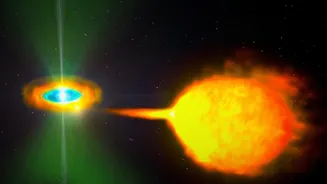
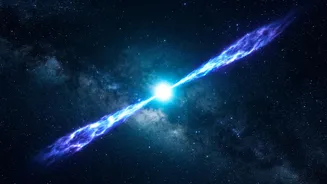
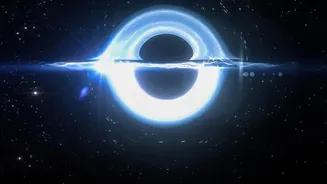
IRAS 18293-0941 is a binary system, meaning it consists of two celestial objects orbiting each other. In this case, it's a black hole about 10 times the mass of our Sun and a very large, hot star. The two complete an orbit around each other roughly every 11 days. The black hole's immense gravity strips material away from its companion star. As this material spirals into the black hole, it forms a structure called an accretion disk. While much of the material falls into the black hole, some is channelled and violently expelled from its poles as two opposing jets of plasma, travelling at around 75% of the speed of light.
Pointed at Earth, But No Cause for Panic
The key detail that makes this system a microblazar candidate is that one of these powerful jets is aimed almost directly at Earth. While this sounds alarming, scientists have been quick to state there is no danger. The primary reason is the immense distance. At 12,000 light-years away, any radiation from the jet is incredibly diffuse by the time it reaches us. To put that distance in perspective, our fastest spacecraft would take tens of thousands of years just to reach the nearest star outside our solar system, which is only four light-years away. The jet itself doesn't travel indefinitely; it collides with interstellar gas and dust far from our solar system, creating a vast, glowing bubble about 100 light-years wide. So, while the 'Earth-facing' alignment is what makes the object so interesting and easier to detect, it poses no identified threat.
A Cosmic Laboratory in Our Backyard
The reason astronomers are so excited is that this discovery provides a relatively close-up laboratory for studying some of the universe's most extreme physics. Blazars powered by supermassive black holes are too far away for us to study in detail. Having a miniature version in our own galaxy allows scientists to test their theories about how these jets are formed, how they're accelerated to near-light speeds, and how they transfer enormous amounts of energy into their surroundings. The discovery of IRAS 18293-0941, which was first catalogued in 1983 but was hidden by a thick veil of cosmic dust for decades, was made possible by combining data from multiple powerful radio telescopes. It may also help solve another major cosmic mystery: the origin of some of the most energetic particles, known as cosmic rays, that constantly bombard Earth's atmosphere.