




A New Martian Puzzle
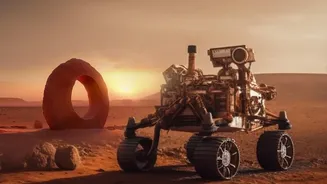
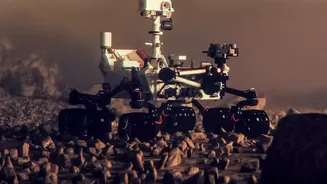
Fourteen years into its mission, the tireless Curiosity rover continues to rewrite our understanding of Mars. While climbing the sulfate-rich slopes of Mount Sharp within the vast Gale Crater, the rover's cameras spotted something unusual dotting the landscape.
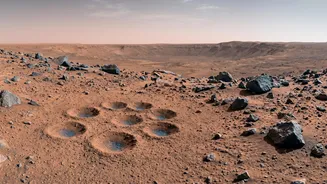
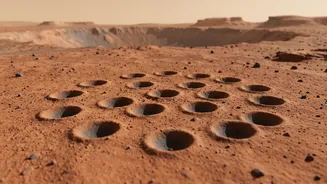
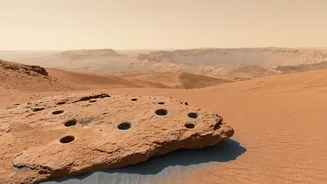
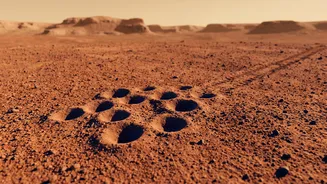
In a region nicknamed Valle Grande, the rover found a scattering of peculiar, shallow pits in the rock. These are not the dramatic impact craters left by meteorites, but small, subtle depressions, with one detailed example measuring just a centimetre across. While holes and pits are a common geological feature on any rocky world, these particular formations immediately stood out to the science team back on Earth as being different from anything the rover had encountered before.
What Makes These Holes Unique?
On both Earth and Mars, small cavities in rock often have a straightforward explanation. Typically, a small, hard object like a pebble or a mineral nodule becomes embedded in softer surrounding rock. Over millions of years, the softer rock erodes away, but the tougher nodule resists for longer. Eventually, it too weathers away or breaks free, leaving behind a small pit — a perfect mold of its former self. The mystery of the new holes in Valle Grande is that this simple explanation doesn't quite fit. According to mission scientists, these pits are unusually broad and shallow compared to previously seen features. More importantly, there are no obvious pebbles or remnant nodules in or around the holes that would suggest they were once filled. Without the “key” that should have created the “lock,” scientists are left with a genuine geological puzzle. As Dr. Michelle Minitti, a lead scientist for one of the rover's cameras, noted in a mission update, Mars continues to surprise even after all this time.
The Search for Answers
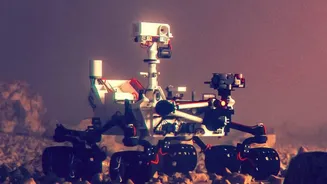
Presented with this unexpected discovery, the rover's science team has turned Curiosity into a planetary detective. They have commanded the rover to halt its ascent and conduct a detailed investigation. Using the Mars Hand Lens Imager (MAHLI), a powerful camera on its robotic arm, Curiosity is taking extreme close-up photos of the pits. Simultaneously, its Mastcam is capturing multiple, overlapping images of the surrounding area. This data will allow researchers at NASA to construct detailed 3D models of the holes and the terrain. By precisely measuring their dimensions—depth, width, and shape—the team hopes to work backward and deduce the geological process that could have formed them. For now, they are wisely avoiding any definitive conclusions. The goal is to gather as much data as possible before proposing a new theory for what might be a previously unknown or unseen erosional process on the Red Planet.
Clues to a Changing World
This discovery isn't just a random curiosity; it's a vital clue in the rover's primary mission. Curiosity has been methodically climbing the 5.5-kilometre-high Mount Sharp since 2014. The mountain is made of sedimentary layers, with each layer representing a different chapter in Mars's ancient history. By analyzing these layers as it ascends, the rover is reading the story of how Mars transformed from a planet with lakes and rivers into the cold, dry desert we see today. The region where the holes were found is already proving fascinating. The rover is transitioning out of a clay-rich area into one dominated by sulfates—minerals often left behind when water evaporates. Scientists have also noted that the rock layers in this area seem to change rapidly, suggesting the ancient environment was undergoing swift transformations. These strange pits, therefore, could hold important information about the specific conditions—perhaps involving water, wind, or unique mineral compositions—that existed during a pivotal period in Mars’s climatic shift billions of years ago.