







Reading the Galactic Fossil Record
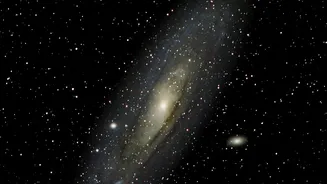
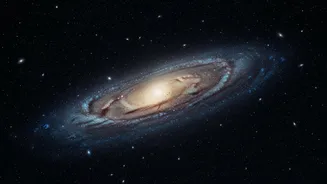
To understand the life story of a galaxy 2.5 million light-years away, astronomers turn to its stars. Using the unparalleled power of the Hubble Space Telescope, scientists conducted a massive census, analysing data on nearly 200 million individual stars across
two-thirds of Andromeda's sprawling disk. This was possible by combining two vast surveys, the Panchromatic Hubble Andromeda Treasury and its southern counterpart. According to the research team, these stars act as a 'fossil record'. Their colours and brightness reveal their age, allowing scientists to create a detailed timeline of when and where the galaxy was most active in producing new suns. Massive, hot blue stars have short lives, indicating recent star birth, while older, cooler red stars point to regions that have long since settled down.
A Precise and Prolonged Slowdown
The data paints a clear picture of a galaxy winding down. The study, published in The Astrophysical Journal, shows that Andromeda’s rate of star formation has been steadily decreasing for about 500 million years. The numbers are striking: half a billion years ago, Andromeda was churning out new stars at a rate of roughly one solar mass per year. By 40 million years ago, that rate had already been cut in half. The decline has become even more pronounced recently, with the current rate plummeting to just one-fifth of a solar mass annually. This is significantly lower than our own galaxy; for comparison, the Milky Way is currently producing new stars at a rate of 3 to 5 solar masses per year. This suggests that while our galaxy is still in a highly active phase, Andromeda has entered a different, quieter chapter.
Taking a Post-Marathon Breather
This decline isn't because Andromeda is running out of the gas and dust needed to forge stars. Instead, the slowdown appears to be a natural phase in its evolution. Much of the galaxy's recent star-making activity has been concentrated in a huge, vibrant ring structure located about 32,000 light-years from its core. The new research shows that the galaxy-wide decline is primarily driven by this ring losing its momentum. Lead author Tobin Wainer, of the University of Washington, poetically compared it to the rest an athlete takes after a major exertion. “It's just like after running a marathon, sometimes you've got to take a bit of a breather,” he said. This 'breather' follows a much more chaotic period about 2 billion years ago, when Andromeda experienced a massive burst of star formation, likely triggered by a merger or close encounter with another galaxy.
The Case of the Pesky Neighbour
While the overall decline is a broad, galaxy-wide trend, astronomers also noticed a localized zone of unusual quiet. In the region of Andromeda's disk closest to its small, compact satellite galaxy, M32, star formation has been suppressed even more than average, a change that began around 60 million years ago. This makes M32 a prime person of interest in this cosmic investigation. While scientists cannot yet definitively prove a cause-and-effect relationship, the timing and location are highly suggestive. Wainer noted that while they can't explicitly blame M32, “It's right there, and it's definitely the most likely suspect.” It's possible that a past interaction with M32, perhaps even a collision where it punched through Andromeda's disk, disrupted the gas clouds in that area and stifled star birth.
Entering Galactic Middle Age
Ultimately, these findings suggest that Andromeda is transitioning from a vibrant, blue-hued galaxy full of hot, young stars to a more placid, red-hued galaxy dominated by older populations. In astronomical terms, it's moving from the 'blue cloud' of active galaxies into the 'green valley'—a transitional phase—on its way to becoming a 'red sequence' galaxy with very little star formation. This process is a key part of the life cycle for massive spiral galaxies. By studying our closest large neighbour in such detail, we gain an invaluable preview of the evolutionary path that galaxies like our own Milky Way might one day follow. It's a reminder that even on the grandest cosmic scales, everything has a life story, with periods of energetic youth, steady maturity, and eventual, quiet retirement.