





A Wanderer at the Edge of Forever
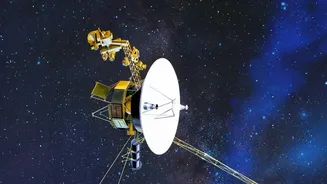
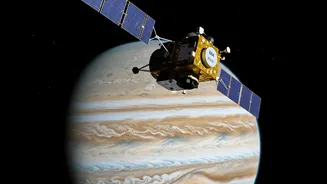
Launched in 1977, Voyager 2 is a testament to human curiosity and engineering. It's the only spacecraft to have ever visited the ice giants Uranus and Neptune, and in 2018, it followed its twin, Voyager 1, into interstellar space—the vast, unknown region
beyond the protective bubble of our sun. It currently sails through the cosmos more than 21 billion kilometres from home, a distance so great that a radio command travelling at the speed of light takes over 19 hours to reach it. For decades, it has faithfully sent back data about this unexplored frontier. But this legendary journey has been running on borrowed time. The probe is powered by a radioisotope thermoelectric generator (RTG), which converts the heat from decaying plutonium into electricity. With its fuel source naturally depleting, Voyager 2 loses about four watts of power every year, forcing NASA to make increasingly difficult choices.
The 'Big Bang' Power Gambit
With power margins becoming razor-thin, engineers at NASA’s Jet Propulsion Laboratory (JPL) faced a grim deadline: they would have to shut down another of the probe's few remaining science instruments by the end of 2026. Instead, they devised a high-stakes solution nicknamed the 'Big Bang'. The name comes from the plan's core concept: simultaneously shutting down a set of power-hungry components and switching to lower-power alternatives in a single, coordinated event. This was not a simple software patch. It was a risky, delicate operation on a nearly 50-year-old spacecraft, billions of kilometres away, with no chance for a do-over if something went wrong. The goal was to claw back just enough power to keep all its current science instruments running, without letting the spacecraft get so cold that it would cease to function in the near-absolute zero of deep space.
How the Interstellar Hack Works
The JPL team executed the 'Big Bang' manoeuvre by sending a series of commands to Voyager 2. These instructions turned off certain hardware, including dedicated heaters, that were consuming precious watts. In their place, other components that use less power but still generate some residual heat were activated to help maintain the spacecraft's operating temperature. It was a brilliant feat of remote engineering, repurposing existing systems in ways they weren't originally designed for. The successful manoeuvre has freed up enough power to postpone the next instrument shutdown for at least one more year. This means the three instruments still actively collecting data—the magnetometer, the Plasma Wave Subsystem, and the Cosmic Ray Subsystem—can continue their work together.
What One More Year Means for Science
An extra year might not sound like much, but in interstellar space, it's a scientific treasure trove. The farther Voyager 2 travels, the more valuable its data becomes. It is our only direct source of information about the environment outside our solar system's heliosphere. The probe measures the cosmic rays, magnetic fields, and plasma that exist between the stars. This information helps scientists understand the shape of our solar system's protective bubble and its role in shielding Earth from high-energy particles. Every additional day of data helps build a more complete picture of our galaxy. The success with Voyager 2 has given NASA the confidence to plan a similar 'Big Bang' manoeuvre for Voyager 1, which is even farther from Earth, in the coming months.
The Enduring Legacy of Voyager
The Voyager missions have fundamentally changed our understanding of the solar system and our place within it. They provided the first detailed images of Jupiter's moons and Saturn's rings, and our only close-up views of Uranus and Neptune. Each probe also carries a Golden Record, a gold-plated copper disc containing sounds and images selected to portray the diversity of life and culture on Earth, intended for any intelligent extraterrestrial life that might find them. Even as their power fades, the probes continue to push the boundaries of exploration. While communications with the probes may cease sometime in the 2030s, their journey will not. Silent and powerless, they will continue to drift through the Milky Way for millions of years, carrying our message to the stars.