





A Cosmic Puzzle
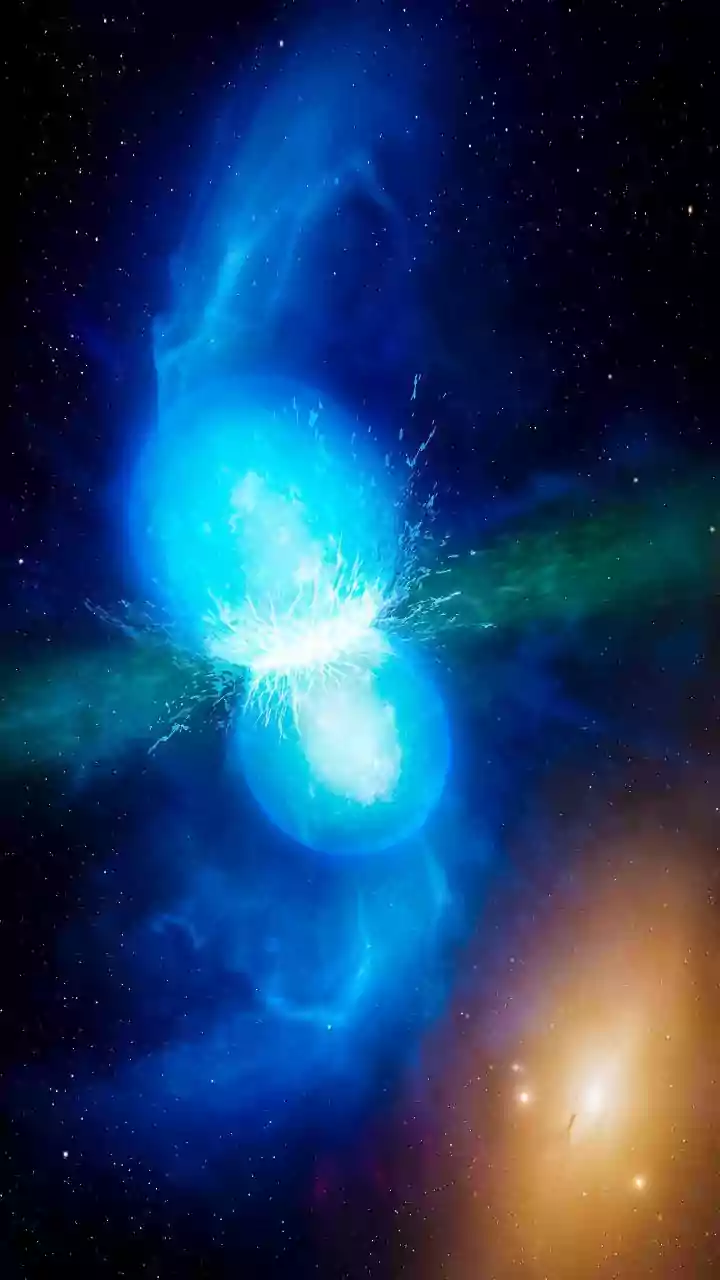
In August 2017, the world of astronomy changed forever. For the first time, scientists detected both gravitational waves and light from the same cosmic event: the collision of two neutron stars 130 million light-years away. This event, catalogued as GW170817,
provided a wealth of information, confirming that these mergers create heavy elements like gold and platinum in a brilliant explosion called a kilonova. But the story didn't end there. As astronomers continued to monitor the aftermath with telescopes like NASA’s Chandra X-ray Observatory, they noticed something strange. After an initial burst that faded as expected, a new, persistent X-ray glow appeared and has lingered for years, long after it should have disappeared. This enduring light has become one of the most intriguing puzzles in modern astrophysics.
The Prime Suspect: A Kilonova Afterglow
The initial theories for the glow struggled to fit the observations. The light didn't behave like a typical gamma-ray burst afterglow. Instead, researchers are now converging on a more exotic explanation: a 'kilonova afterglow'. The idea is that the initial explosion sent a powerful shockwave of ejected material hurtling into the surrounding interstellar gas. Think of it like a cosmic sonic boom. As this fast-moving debris crashes into the material filling the space around the merger, it heats it to millions of degrees, causing it to glow brightly in X-rays. This process would explain why the glow emerged later and has persisted for so long. It’s not the original explosion we are seeing, but its powerful, lingering impact on its environment.
What Happens When Neutron Stars Collide?
To understand the glow, we have to appreciate the sheer violence of the event that created it. Neutron stars are the collapsed cores of massive stars, so incredibly dense that a teaspoonful would weigh billions of tons. When two of these objects, locked in a decaying orbit, finally smash together, the energy released is immense. The collision sends ripples through spacetime, which we detect as gravitational waves. It also unleashes powerful jets of particles travelling at nearly the speed of light and creates a kilonova explosion, a thousand times brighter than a standard nova. The material blasted out from this cataclysm contains newly forged heavy elements, which then create the shockwave that produces the mysterious afterglow. The event, GW170817, was a perfect laboratory for studying this process because the jet wasn't pointed directly at Earth, allowing scientists to study the surrounding explosion more clearly.
Piecing Together the Evidence
The case for a kilonova afterglow rests on how the light has behaved over time. Initially, about nine days after the merger was detected, the source began to glow across the spectrum, peaking around 160 days before fading rapidly. This was the signature of the relativistic jet. But while the light faded in most wavelengths, the X-ray glow plateaued in 2020 and has remained relatively steady since. This behavior doesn't fit a simple jet model. According to Aprajita Hajela of Northwestern University, who has studied the event, scientists have entered 'uncharted territory' and are observing new physical processes for the first time. An alternative theory is that the X-rays are coming from material falling back onto the object created by the merger—likely a new, low-mass black hole. Future observations, particularly in radio wavelengths, will be key to distinguishing between these two fascinating possibilities.
Solving a Galactic Mystery
Confirming the source of this glow will have major implications for our understanding of the universe. If it is a kilonova afterglow, it implies the merger did not immediately create a black hole, giving astronomers a chance to study the exotic object left behind. If it is material falling onto a newly-born black hole, it provides an unprecedented opportunity to watch how these enigmatic objects feed in the years after their birth. Whatever the answer, the persistent glow from GW170817 has transformed a single, historic event into a long-term cosmic experiment. It serves as a powerful reminder that even after the initial fireworks of a cosmic collision are over, the aftermath can hold even more profound secrets about the fundamental workings of our universe.