







A Journey of Historic Firsts
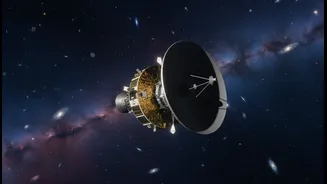
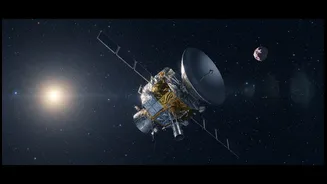
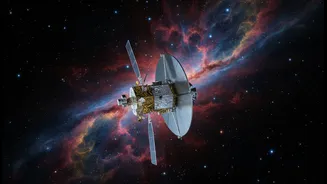
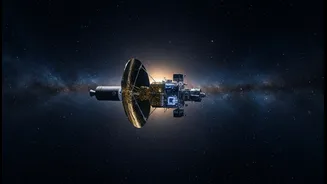
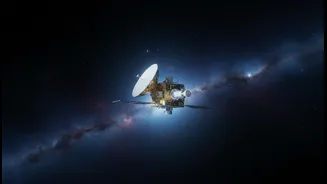
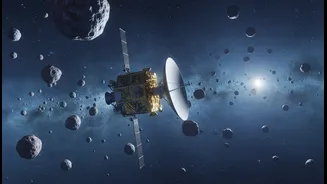
Launched in 2006, New Horizons is one of the most storied explorers of our time. It holds the record for the highest launch speed of any human-made object from Earth, a velocity that sling-shotted it towards the outer solar system. After a gravity-assist
from Jupiter in 2007, it embarked on a lonely nine-year voyage to its primary target. In July 2015, it made history by performing the first-ever flyby of Pluto, transforming our understanding of the dwarf planet from a distant, fuzzy point of light into a dynamic world with towering ice mountains, vast nitrogen glaciers, and a surprisingly complex atmosphere. But its work wasn't done. On New Year's Day 2019, it broke its own record for the most distant planetary encounter, studying a primordial Kuiper Belt object named Arrokoth, a snowman-shaped relic from the dawn of our solar system.
The Logic of Deep Sleep
For a spacecraft travelling so far from the sun, power is a precious and finite resource. Mission operators at the Johns Hopkins Applied Physics Laboratory (APL) routinely place New Horizons into hibernation to conserve energy and extend its operational life. During these long cruise periods between points of interest, much of the spacecraft is powered down, entering a stable, spinning mode. This recent nap was its 23rd and longest, lasting 321 days. However, hibernation doesn't mean it stops working entirely. Three of its science instruments—which measure solar wind particles, energetic particles, and space dust—continued to gather and store data around the clock, effectively making it a vigilant sentinel even while 'asleep'. Weekly status beacons sent back to Earth confirmed its health, with every report coming back 'green' during its long slumber.
What Happens Now?
With the spacecraft now fully active, the first order of business for the mission team is to perform a thorough health check. It takes nearly nine hours for a signal to travel from New Horizons to Earth, so this process is deliberate and methodical. Once the probe's safety and stability are confirmed, the team will begin the slow process of downlinking the science data collected during its hibernation. This information provides a unique look at the environment of the Kuiper Belt, a region no other active mission is currently exploring. In the coming weeks, the probe will turn its attention to new tasks, including using its ultraviolet spectrograph to study the distribution of hydrogen gas at the far edge of our solar system’s heliosphere, the vast bubble of influence created by our sun.
The Hunt for a New Target
While studying the environment of the Kuiper Belt is a key goal of its extended mission, the team holds out hope for one more dramatic encounter. New Horizons has enough fuel to maneuver towards another Kuiper Belt Object (KBO) if a suitable one can be found in its path. The challenge is immense; potential targets are small, dark, and incredibly far away. Scientists are using powerful Earth-based telescopes, like the Vera C. Rubin Observatory, to scan the skies ahead of the spacecraft, hunting for a reachable worldlet. Even without a new flyby, New Horizons is pushing frontiers. Its observations have already suggested that the Kuiper Belt may be much larger than previously thought, or that there might even be a second, more distant belt of icy objects. Either discovery would fundamentally change our models of how planetary systems form.