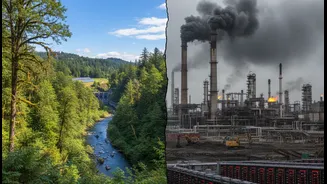











An Insatiable Appetite for Power
At the heart of the conflict is a simple reality: artificial intelligence is incredibly hungry for energy. The computational power needed to train and run large-scale AI models requires vast data centers filled with power-intensive hardware. Recent reports
show this demand is skyrocketing. Global data center electricity consumption is projected to grow 26% in 2026 alone, with AI-optimized servers being the primary driver. By 2027, these specialized servers are expected to consume more power than all conventional data center hardware combined. This surge is directly reflected in the environmental reports of tech giants. In their most recent disclosures, companies like Google, Amazon, and Microsoft have all reported significant year-over-year increases in emissions, attributing the spike to their AI infrastructure buildout. Google's emissions jumped 18% in 2025, while Amazon's rose 16%. Microsoft saw a 25% increase year-over-year, with its emissions now sitting 58% above its 2020 baseline. This trend is forcing a difficult conversation, with Google acknowledging that its "AI infrastructure build-out is currently accelerating faster than the grid is decarbonizing."
The Hidden Water Footprint
Beyond electricity, AI's environmental toll includes another critical resource: water. Data centers generate immense heat and rely on vast quantities of water for cooling. While exact figures are often proprietary, the scale is significant, with some large data centers consuming as much water as a small city. This creates pressure on local water supplies, particularly as many new data centers are built in water-stressed regions. Recent reports have highlighted the rising water consumption of major tech firms. Amazon, for example, noted its data centers used nearly 2.5 billion gallons of water in one year. The rapid expansion of AI is only expected to worsen this strain. However, companies are aware of the issue and are investing in new cooling technologies. Microsoft has announced new data center designs that use closed-loop cooling systems, which dramatically reduce water consumption by recycling the same water. The company claims these new facilities consume an amount of water annually that is roughly equivalent to a single restaurant.
A Collision with Climate Pledges
This surge in resource consumption puts tech companies in a difficult position, as it directly challenges their highly publicized climate pledges. Google has a target for net-zero emissions by 2030, while Amazon aims for 2040 and Microsoft has pledged to be carbon negative by 2030. Yet, the recent emissions data shows a trend moving in the opposite direction. For the first time since 2019, Amazon reported a rise in its "carbon intensity," a metric that measures emissions relative to revenue, suggesting its environmental impact is growing faster than its business. This reversal comes after years of progress for many firms. The dilemma is that the race to dominate the AI market is a key strategic priority, driven by investor expectations and technological competition. This has created a situation where ambitious climate goals are now in direct conflict with core business objectives, forcing companies to acknowledge the tension publicly. In its sustainability report, Amazon noted that demand for AI products could "slow us down" in achieving environmental goals.
Can Innovation Close the Gap?
The tech industry argues that innovation can solve the problem it is creating. Companies are actively researching more energy-efficient AI models and hardware. Google, for instance, reported that it had dramatically decreased the energy consumption per query for its Gemini models through efficiency improvements. Similarly, both Amazon and Microsoft highlight innovations in data center design, from more efficient power usage to deploying recycled water for cooling. There is also the argument that AI itself can be a powerful tool for climate action, helping to optimize energy grids, design more sustainable materials, and monitor deforestation. The hope is that the emissions reductions enabled by AI applications will eventually outweigh the emissions generated by the AI infrastructure itself. However, critics argue that these benefits are still largely unproven, while the environmental costs of the AI boom are immediate and growing rapidly. For now, the path to reconciling AI's explosive growth with a sustainable future remains uncertain.