




An Ocean World of Promise
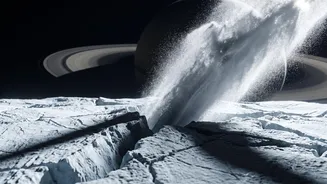
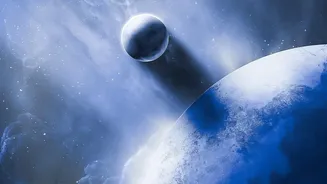
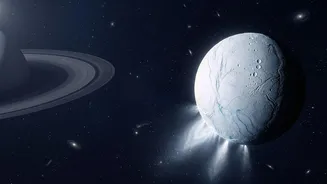
Enceladus might look like a tiny, frozen snowball, but beneath its icy crust lies its most exciting secret: a vast, global ocean of liquid saltwater. What makes this moon especially tantalizing for scientists is that it isn't shy about sharing. Huge plumes
of water vapour and ice grains continuously erupt from deep fractures near its south pole, jetting hundreds of kilometres into space. These geysers, discovered by NASA's Cassini spacecraft, offer a direct sample of the ocean's chemistry. Analysis of these plumes has already confirmed the presence of salts, methane, and various organic molecules—the fundamental building blocks for life. The new findings add a crucial layer, suggesting this alien ocean might be far more accommodating to life than we once thought.
Life in a Test Tube
To test the habitability of Enceladus, a team of researchers recreated the moon's likely ocean conditions in a lab. They concocted a briny, highly alkaline solution with a pH up to 11, containing minerals and dissolved gases meant to mimic the environment near hydrothermal vents on the moon's seafloor. Into this miniature alien ocean, they introduced a specific type of Earth microbe: Methanothermococcus okinawensis. This single-celled organism, a type of archaea, thrives near deep-sea hydrothermal vents on Earth, converting hydrogen and carbon dioxide into methane to survive, all without oxygen. To the scientists' surprise, the microbe didn't just survive; it thrived. It adapted to the harsh, carbon-dioxide-limited environment by using hydrogen generated from water-rock reactions in the experiment, continuing to produce methane—a sign of active metabolism.
A Trail of Frozen Breadcrumbs
Proving that life could survive is one thing, but finding it is another challenge entirely. This is where the second part of the new research comes in. The study suggests that the process by which ocean water freezes and erupts into space could make detecting life easier. As droplets of ocean water travel up through the icy cracks, they freeze slowly. This gradual freezing separates and concentrates different compounds, including any organic molecules or cellular fragments that might be present. These concentrated bits then get blasted into space as individual ice grains. In astrobiology, these detectable traces of life are called "biosignatures." A biosignature can be any substance or pattern that provides evidence of past or present life, from specific molecules to isotopic ratios that are unlikely to be produced by non-biological processes. The new findings suggest that if life exists on Enceladus, its biosignatures could be concentrated in these ice grains, making them easier for a visiting spacecraft to identify.
Searching for the Signs
These findings have profound implications for future missions to Enceladus. They reinforce the idea that a spacecraft wouldn't need to land and drill through kilometres of ice to find evidence of life. Instead, an orbiter could simply fly through the plumes multiple times, collecting and analysing the ice grains for these concentrated biosignatures. The research suggests that existing technology on a well-equipped spacecraft could potentially identify microbial material in a single ice grain. While these experiments do not prove that life exists on Saturn's moon, they remove another barrier and strengthen the scientific case for its potential habitability. They tell us that if an organism similar to one found on Earth were on Enceladus, it would have a good chance of surviving. This makes the call to return to this distant, icy world more compelling than ever, armed with the knowledge of not only what to look for, but how to find it.