





A Cosmic River Named Alaknanda
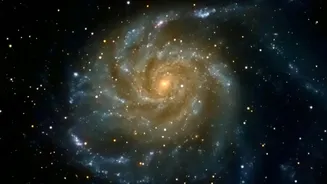
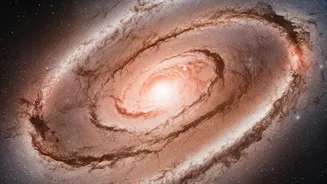
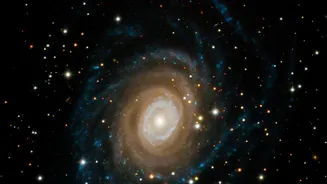
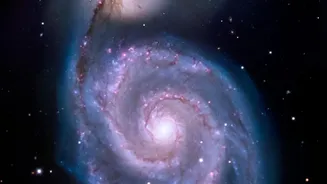
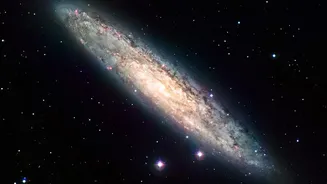
In the vast, dark expanse of the early universe, astronomers have spotted something that looks surprisingly familiar: a majestic spiral galaxy with two well-defined arms, much like our own Milky Way. This remarkable celestial object has been given an equally
remarkable name: Alaknanda. The name, chosen by the Indian astronomers who discovered it, is a beautiful tribute to the Himalayan river that is one of the headstreams of the Ganga. The connection is poetic and profound; the other headstream, the Mandakini, is also the Hindi name for the Milky Way. The naming creates a celestial parallel, presenting Alaknanda as a cosmic twin or sister river to our own galaxy, linking a discovery at the edge of time with a landmark central to Indian geography and culture.
An Impossible Structure in the Early Universe
So, what makes Alaknanda so special? It’s all about its age and its shape. The light from this galaxy has travelled for over 12 billion years to reach us, meaning we are seeing it as it was when the universe was just 1.5 billion years old. According to long-held cosmological theories, galaxies in this infant era of the cosmos were supposed to be chaotic, clumpy, and irregular messes. The universe was a violent place, and it was thought to take billions of years for gravity to tame that chaos, allowing gas and stars to settle into the elegant, ordered spiral structures we see in mature galaxies like the Milky Way. Alaknanda defies this timeline. It already possesses the 'grand design' of a mature galaxy, with two clear, symmetric spiral arms. Finding such a well-organized structure so early in cosmic history is like finding a fully-grown tree in a bed of freshly planted seeds—it challenges everything we thought we knew about how quickly things can grow.
The Indian Minds Behind the Discovery
This groundbreaking discovery was made by a team of Indian researchers, putting India at the forefront of modern cosmology. Rashi Jain and Yogesh Wadadekar, astronomers at the National Centre for Radio Astrophysics (NCRA) of the Tata Institute of Fundamental Research (TIFR) in Pune, were the ones who identified Alaknanda. While studying a flood of data from the James Webb Space Telescope, they spotted the galaxy that seemed out of place. Their meticulous analysis, later published in the prestigious journal Astronomy and Astrophysics, confirmed its extraordinary nature. In a press release, the researchers noted that Alaknanda possesses a “structural maturity” usually associated with galaxies billions of years older, forcing a fundamental rethink of the processes that drive galaxy formation.
A Cosmic Magnifying Glass
Observing such a distant and ancient object in such detail is a monumental technological feat. The discovery was made possible by the unparalleled power of NASA's James Webb Space Telescope (JWST), whose infrared instruments are specifically designed to peer back into the dawn of time. But even for the JWST, Alaknanda was a difficult target. Nature, however, provided a helping hand in the form of a 'cosmic magnifying glass.' The galaxy is located behind a massive galaxy cluster known as Abell 2744. The immense gravitational pull of this cluster bends and magnifies the light from Alaknanda as it passes by, an effect known as gravitational lensing. This phenomenon made Alaknanda appear brighter and larger, allowing Jain and Wadadekar to resolve its stunning spiral structure in detail that would have otherwise been impossible.
Rewriting the Astronomy Textbooks
The existence of Alaknanda is not just a curiosity; it's a direct challenge to the standard model of cosmic evolution. It suggests that the physical processes responsible for creating galaxies—like the pulling in of gas, the settling of matter into a rotating disk, and the formation of spiral arms—can happen much faster and more efficiently than our current models predict. Co-author Yogesh Wadadekar noted that Alaknanda somehow managed to gather ten billion times the mass of our sun and organize it into a spiral in just a few hundred million years, an extraordinarily rapid assembly by cosmic standards. While a single galaxy can’t overturn a whole theory, Alaknanda joins a growing list of perplexing discoveries made by the JWST that show the early universe was far more developed and orderly than previously imagined, compelling scientists to go back to the drawing board.