



Imagine finding a set of perfectly preserved fossils from the moment life began on Earth. NASA's Lucy mission is on a similar quest, embarking on a 12-year journey to cosmic 'fossils' that could rewrite the story of how our solar system was born.
Meet the Solar System's Time Capsules
The targets
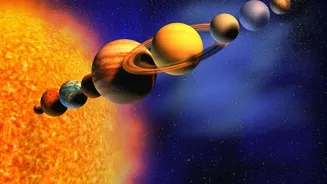
of Lucy's ambitious quest are the Trojan asteroids, two large swarms of space rocks that share Jupiter's orbit around the sun. One group, the 'Greek camp,' travels 60 degrees ahead of Jupiter, while the 'Trojan camp' trails 60 degrees behind. Held in place by the gravitational sweet spots created by the Sun and Jupiter, these asteroids are thought to be pristine remnants from more than four billion years ago. Scientists believe they are leftovers from the same primordial material that formed the giant outer planets. By studying them up close for the first time, we can effectively look back in time, gathering vital clues about how planets, including our own, came to be.
An Unprecedented Interplanetary Itinerary
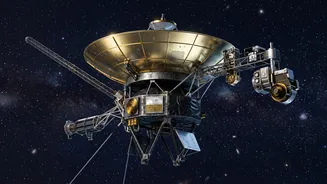
The Lucy mission is an epic road trip of cosmic proportions. Launched in October 2021, the spacecraft is on a complex 12-year trajectory that involves multiple gravity-assist flybys of Earth to build up speed and adjust its course. Its journey is a record-breaker; Lucy is the first single spacecraft in history designed to visit so many different asteroids. Before it even reaches its main targets, Lucy has already performed flybys of two main-belt asteroids, Dinkinesh in 2023 and Donaldjohanson in 2025, as a kind of operational dress rehearsal. The first Trojan encounter is set for August 2027, when Lucy will visit Eurybates and its satellite Queta. Over the following years, it will investigate several more Trojans before a final flyby in 2033.
Why 'Lucy'?
The mission's name is a direct homage to the famous fossilized skeleton of an early hominin ancestor discovered in 1974. That 'Lucy' fossil fundamentally changed our understanding of human evolution. In the same spirit, the Lucy spacecraft aims to revolutionize our understanding of the solar system's evolution by studying its 'fossils'. The targets are incredibly diverse in their characteristics, which suggests they may have formed in different parts of the solar system before being captured into their current orbits. Unlocking the story of why they are so different is one of the mission's central goals.
A Toolkit for Uncovering Ancient Secrets
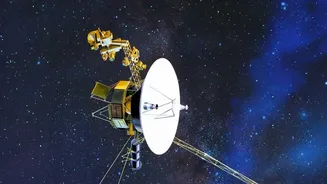
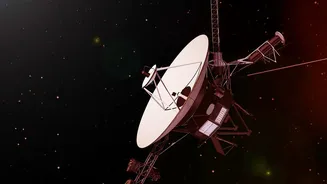
To analyze these distant worlds, Lucy is equipped with a suite of advanced scientific instruments. These include a high_resolution imager (L'LORRI), a color camera and infrared spectrometer (L'Ralph), and a thermal infrared spectrometer (L'TES). Together, this payload will allow scientists to map the asteroids' geology, surface composition, and physical properties from afar. The L'Ralph instrument, for example, will look for the presence of materials like ice and organics, while the thermal spectrometer will measure the temperature of the asteroids, providing clues about their surface texture and composition. By measuring how the spacecraft's radio signal is affected as it passes each asteroid, scientists can even determine the mass and density of these mysterious objects.
A Long Journey Towards a New Beginning
Even five years into its journey as of late 2026, the most exciting chapters of Lucy's mission are still ahead. The first encounter with a Trojan asteroid in 2027 will mark the beginning of a new era in planetary science. Each flyby is a carefully choreographed event lasting only a matter of hours, during which the instruments will work furiously to collect as much data as possible. The mission's journey will take it to both the leading and trailing swarms of Trojans, providing an unprecedented comparative look at these two distinct populations. After its final flyby in 2033, the spacecraft will continue in a stable orbit, a silent monument to human curiosity. The data it sends back, however, will keep scientists busy for decades, piecing together the four billion year old story of our solar system's birth.