


The Cosmic Crime Scene
Around 10 to 11 billion years ago, long before our Sun was born, the young Milky Way was not alone. It was on a collision course with a smaller, yet still massive, dwarf galaxy. Astronomers have nicknamed this other galaxy the 'Gaia-Sausage-Enceladus'
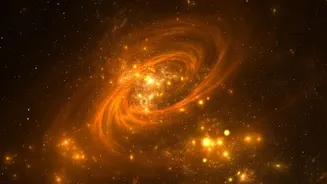
or simply 'Gaia Sausage'. The name comes from data collected by the European Space Agency's Gaia mission, which showed that stars from this destroyed galaxy now move in elongated, sausage-shaped orbits within our own. This wasn't a gentle merger; it was a cataclysmic, head-on crash. The collision was the most significant event in our galaxy's early history, tearing the Gaia Sausage galaxy to shreds and scattering its stars, which the Milky Way then absorbed.
Solving a Galactic Puzzle
This new theory emerged while astronomers were trying to solve a long-standing puzzle. Surrounding the Milky Way's main disk is a vast, sparse sphere of stars called the stellar halo. Data from the Gaia mission revealed that while the stars in our disk spin rapidly, the halo rotates surprisingly slowly. This discrepancy has puzzled scientists for years. To find an answer, a team from Durham University ran sophisticated supercomputer simulations, modelling the evolution of 25 different Milky Way-like galaxies over billions of years. Their results were striking: simulated galaxies that experienced both a major head-on collision and had a very slow-rotating halo also had something else in common—their entire disk had flipped over.
A Galaxy-Wide Somersault
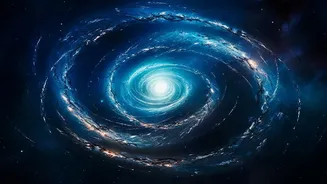
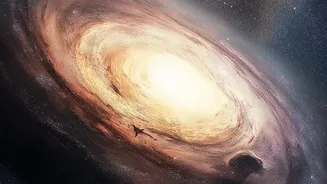
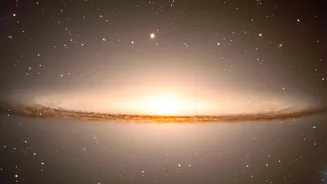
So what does it mean for a galaxy to 'flip'? It wasn't a quick event, but a gradual process that may have taken hundreds of millions of years. The gravitational chaos from the collision with the Gaia Sausage exerted a powerful torque on the Milky Way's disk, slowly tilting it. Over time, this tilt became extreme, with the new research suggesting a reorientation of more than 90 degrees. Our entire galaxy effectively turned itself onto its side. According to the lead researcher, Kirill Batrakov, the team can't be 100% certain this happened, but based on their simulations, it is the most likely explanation for the halo's slow rotation. The evidence isn't just in simulations; other independent studies have also found hints of a major reorientation, including evidence that the Milky Way’s invisible dark matter halo is oriented almost vertically to the starry disk we see today.
A New Chapter in Our History
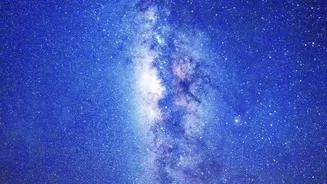
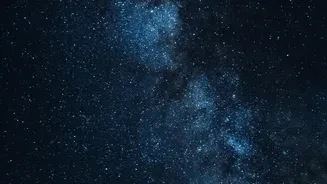
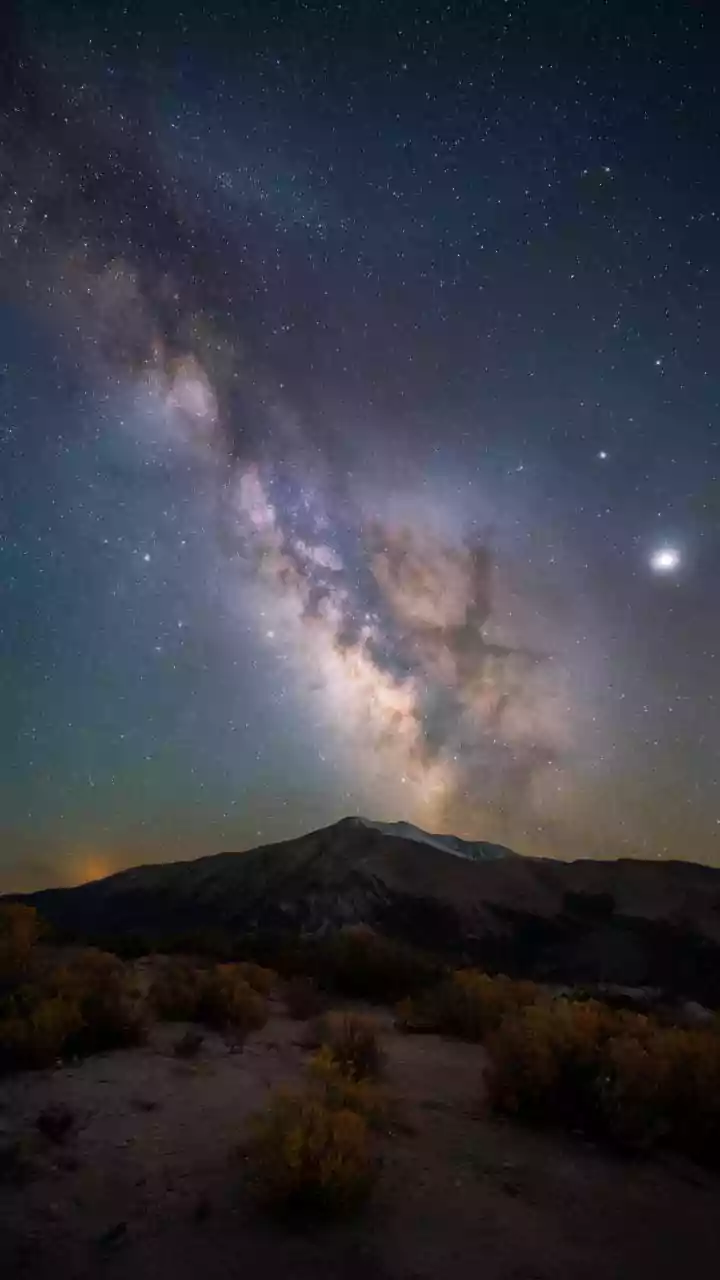
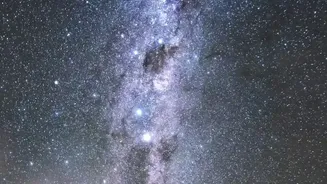
This discovery doesn't just solve the puzzle of the slow halo; it fundamentally changes our understanding of how our galaxy was built. It suggests that the Milky Way’s structure wasn't formed through a calm, steady process, but was dramatically reshaped by violent events. The collision puffed up the early galactic disk and scattered stars everywhere, contributing to the formation of the Milky Way’s central bulge and its surrounding halo. This means that everything, including the path our own Sun takes through the galaxy, was influenced by this ancient crash. The tranquil band of stars we see in the night sky is a beautiful remnant of a much more chaotic and dynamic past, a history that astronomers are only now beginning to piece together.