




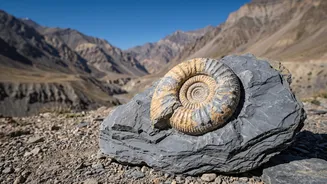
An Ocean's Ghosts on the Roof of the World
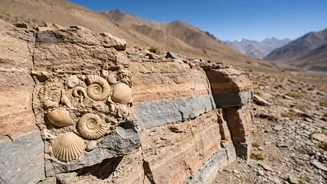
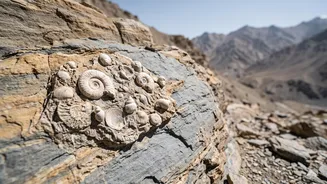
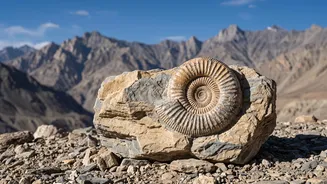
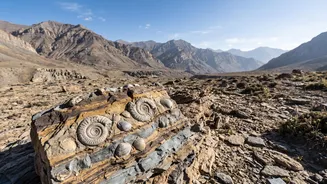
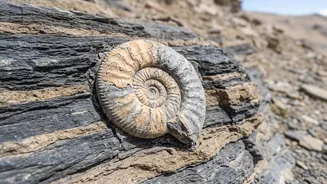
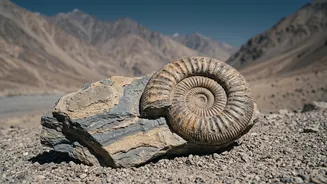
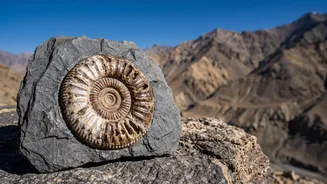
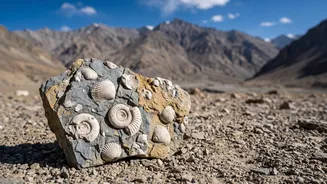
In the cold, arid landscape of Nyoma in eastern Ladakh's Changthang region, a geologist has uncovered a remarkable collection of marine fossils. Dr. Ritesh Arya, founder of the Tethys Fossil Museum, discovered an assemblage of spiral-shaped gastropods,
bivalves, and oyster-like forms, creatures that once lived in a warm, shallow sea. This find is startling because Ladakh is a high-altitude desert, thousands of metres above sea level. Finding evidence of marine life here is a direct contradiction to the environment we see today. The initial surprise for the scientists was how similar these fossils looked to those regularly found in the Subathu formation in the outer Himalayas, but discovering them so far east in Ladakh was unexpected. This discovery builds on earlier work in the region and provides a substantially larger collection for detailed study, hinting at a story of immense geological change.
The Lost Tethys Ocean
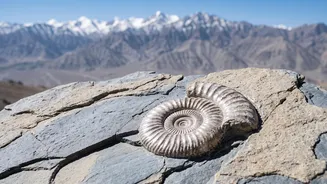
The existence of marine fossils in the Himalayas is not entirely new; they have even been found near the summit of Mount Everest. These discoveries are tangible proof of the Tethys Ocean, a vast body of water that once separated the Indian tectonic plate from the Eurasian plate millions of years ago. Long before the Himalayas existed, the land that is now India was an island continent drifting northwards across this ancient ocean. The floor of the Tethys Sea was covered in sediments, including the shells and remains of countless marine organisms. As these layers of sediment accumulated, they hardened into rock, preserving the life within them as fossils. These are the very fossils now being found scattered across the Himalayan range, from Spiti to Nepal and now, with new clarity, in Ladakh.
A Collision of Continents
The story of how these oceanic fossils reached such staggering heights is the story of the Himalayas' birth. Around 50 million years ago, the northward-drifting Indian plate finally collided with the Eurasian plate. This was not a sudden crash but a slow, monumental collision that continues to this day. The immense pressure between the two converging landmasses buckled and folded the Earth's crust. The seabed of the Tethys Ocean was squeezed, crumpled, and thrust upwards, carrying its fossil-rich sedimentary rocks with it. This colossal process of upliftment formed the world's highest mountain range. The fossils, therefore, are not just ancient relics; they are markers of a former ocean floor that has been lifted kilometres into the sky.
What 34-38 Million Years Adds Context To
The specific age of the Nyoma fossils is what makes this discovery so significant. A preliminary assessment dates them to between 34 and 38 million years ago, placing them in the Eocene epoch. This specific timeframe is crucial because it helps to precisely date the final stages of the Tethys Ocean in this region. This wasn't just any ocean; it was the last remnant of a sea that was closing as the Indian and Asian continents drew together. By establishing that a shallow marine environment existed here during this period, scientists can better understand the timeline of the Himalayan formation. The fossils suggest that the Subathu Sea, a part of the Tethys, extended much farther east into Ladakh than previously thought, reshaping our understanding of the region's paleogeography just before the final continental collision.
Rewriting India's Deep History
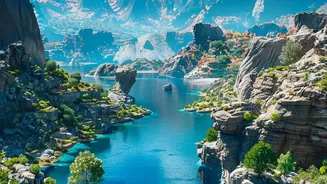
These fossils do more than just confirm a long-lost ocean. They paint a vivid picture of what Ladakh was like nearly 40 million years ago: a warm, near-coastal environment with palm trees and subtropical vegetation, a stark contrast to the cold desert of today. The detailed study of these fossils—identifying the exact species and their place in the geological layers—will allow scientists to reconstruct ancient environments with greater accuracy. This knowledge is invaluable, offering insights into long-term climate shifts, the evolution of biodiversity, and the powerful tectonic forces that shaped the Indian subcontinent. Each fossil shell is a data point, helping to refine the epic story of how the land beneath our feet came to be.