






The 'Bathtub Ring' on Mars
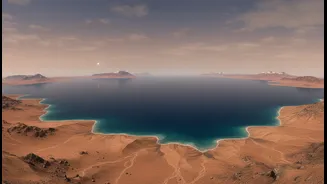
Imagine draining a bathtub and seeing a distinct ring left behind. Scientists have found a planetary-scale version of that on Mars. Researchers from Caltech and the University of Texas at Austin, after analysing topographic data from Mars orbiters, identified
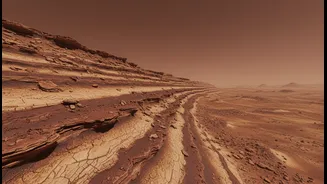
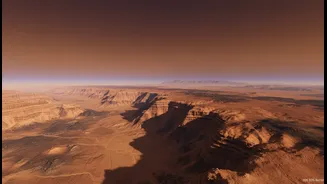
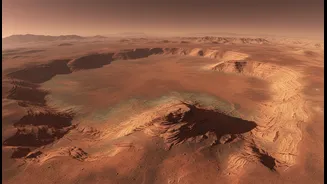
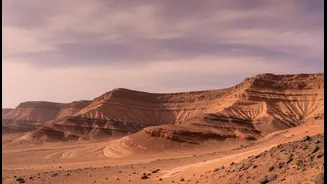
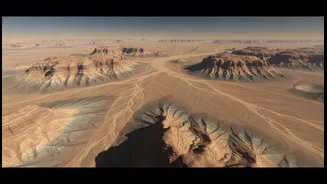
a huge, flat band of land that wraps around the northern hemisphere. This feature strongly resembles the continental shelves found on Earth, which are the submerged edges of continents that gently slope into the deep ocean. This Martian 'coastal shelf' is a massive structure, hundreds of kilometres wide in places, suggesting it was formed by a very large, stable body of water. The finding, published in the journal Nature, is being hailed as one of the most robust pieces of evidence for the long-debated theory of a primordial Martian ocean.
Why This Is Stronger Evidence
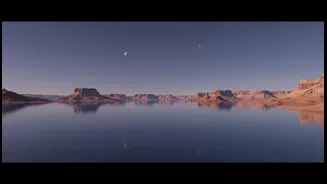
For years, the evidence for a Martian ocean has been tantalizing but inconclusive. Previous missions identified features that looked like ancient shorelines, but they were often found at inconsistent elevations. If they were from a single, stable ocean, they should all be at the same level, like sea level on Earth. This new discovery bypasses that problem by looking for a more durable geological signature. A coastal shelf is a much larger and more stable landform than a delicate shoreline, which can be easily erased by billions of years of wind erosion and volcanic activity. The presence of this shelf implies not just a fleeting flood, but a persistent ocean that existed for potentially millions of years, long enough to carve such a massive feature into the planet's crust.
Connecting the Dots of a Watery Past
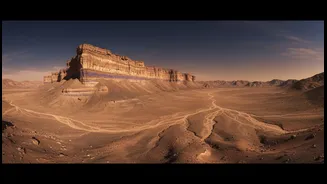
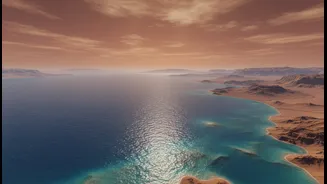
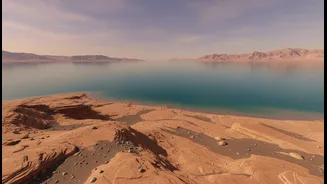
This discovery doesn't exist in a vacuum. It helps tie together other clues about water on Mars that scientists have been gathering for decades. For instance, the newly identified shelf aligns with the locations of previously discovered river deltas. On Earth, deltas form where rivers empty into a large body of water, like an ocean or sea. Seeing these Martian deltas line up with the edge of the proposed coastal shelf makes the case for an ancient ocean much stronger. It paints a picture of a Mars with a dynamic water cycle, where rivers flowed from the southern highlands and deposited sediment into a vast northern ocean, covering as much as a third of the planet's surface.
A New Roadmap for Finding Life
The existence of a long-lived ocean fundamentally changes the calculation for whether life could have ever existed on Mars. While not proof of life itself, stable liquid water is considered the most critical ingredient. An ocean that was around for millions of years would have provided a much more stable environment for life to potentially emerge and evolve than transient lakes or streams. This discovery provides a new roadmap for future missions. The sedimentary deposits along this ancient coastal shelf are now prime targets in the search for biosignatures—the preserved signs of past life. Just as fossils are often found in Earth's coastal sediments, these Martian shelf deposits could hold the key to answering one of science's biggest questions. Future rovers could one day drill into these layers to look for the chemical traces of ancient Martian biology.