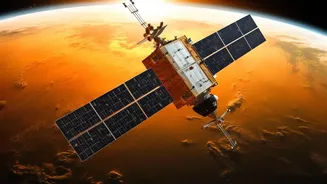









Meet India's Watchful Eye
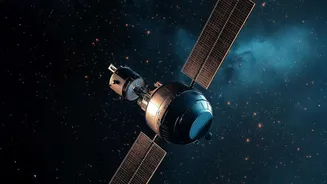
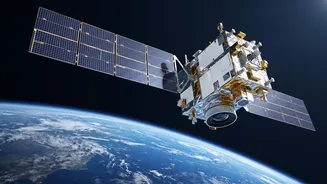
Launched in early September 2026 aboard a GSLV-F17 rocket, EOS-05 is a state-of-the-art Earth observation satellite. What makes it special is its destination: a geosynchronous orbit approximately 36,000 kilometres above the Earth. Unlike most imaging
satellites that circle the planet in low orbits and revisit a location only periodically, EOS-05 stays locked in with the Earth's rotation. This allows it to continuously monitor a vast area of the Indian subcontinent and surrounding regions, providing near real-time imagery. After its launch, the Indian Space Research Organisation (ISRO) performed a series of successful orbit-raising manoeuvres to place the 2,367 kg satellite into its final operational slot.
The Geosynchronous Advantage
The key innovation of EOS-05 is its ability to provide a constant gaze. Satellites in Low Earth Orbit (LEO), like those in the Cartosat or RISAT series, capture incredibly detailed images but pass over a specific area for only a few minutes at a time. EOS-05, from its high perch, trades some of that fine detail for persistence. This capability is a game-changer for tracking rapidly evolving events. Think of cyclones forming over the ocean, the spread of a forest fire, or the real-time progress of flooding. This continuous monitoring provides invaluable data for disaster management agencies, allowing for quicker response times and more accurate assessments of an unfolding situation.
A Strategic Asset in the Sky
The applications of EOS-05 are not limited to civilian use. ISRO has openly described it as a “strategic” satellite. Its ability to offer persistent surveillance over areas of interest has significant implications for national security. From monitoring borders to keeping an eye on maritime activities in the Indian Ocean, the satellite provides a layer of oversight that is both powerful and discreet. The Indian Navy is expected to be one of the key users of its imaging capabilities. This dual-use capability—serving both developmental and defence needs—makes EOS-05 a critical component of India's national infrastructure.
The Latest Development
The successful launch and placement of EOS-05 into its final orbit this month represents a major milestone and the most significant recent development. It marks a powerful recovery and a vote of confidence in the GSLV launch vehicle, especially after a previous mission carrying the similar EOS-03 failed in 2021. With EOS-05 now in orbit and undergoing final checks before its systems are fully activated, the immediate next step involves calibrating its advanced imaging payloads. ISRO chairman V. Narayanan highlighted that with this launch, India is targeting six more launches within the financial year, including the first uncrewed mission for the Gaganyaan programme, signalling a renewed momentum in India's space ambitions.
The Bigger Picture for India
EOS-05 does not operate in isolation. It is a vital part of India's broader Earth observation programme, which is one of the largest in the world. This network of satellites provides a wealth of data for everything from urban planning and agricultural assessment to mineral prospecting and environmental monitoring. The addition of a geosynchronous imaging satellite complements the existing constellation of polar-orbiting satellites, creating a more robust and responsive system. This success also enhances India's position as a major space-faring nation, building on recent triumphs like the Chandrayaan-3 lunar landing and the Aditya-L1 solar mission. It reinforces the country's self-reliance in critical space technologies and its ability to execute complex missions.