







The Making of a Myth
The dodo's reputation problem began almost as soon as it was discovered. Living an isolated existence on the island of Mauritius, the flightless bird had no natural predators for millions of years. When Dutch sailors arrived in the late 1500s, the dodos
showed no fear, making them incredibly easy to hunt. This apparent lack of survival instinct, which scientists call "ecological naïveté," was misinterpreted as stupidity. The name 'dodo' itself may come from a Portuguese word for 'fool'. Within a century of human arrival, the dodo was gone, hunted to extinction and out-competed by invasive species like pigs and rats. Its story became a cautionary tale, and its image—often depicted as fatter and clumsier than it likely was—was cemented in popular culture as an icon of ineptitude. For over 300 years, this was the only story we had.
A High-Tech Look Inside a Famous Skull
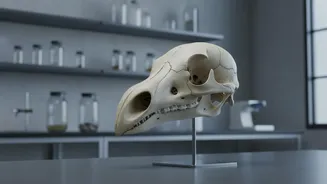
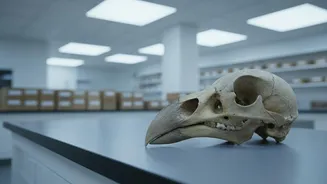
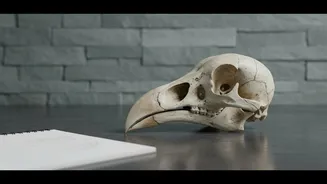
Modern science, however, is offering a powerful rebuttal. An international team of researchers gained unprecedented access to the world's only two complete dodo skulls, housed at the Natural History Museum Denmark and the Oxford University Museum of Natural History. Using high-resolution CT scans, they were able to create detailed 3D digital models of the skulls' interiors without damaging the priceless specimens. This technique allows scientists to create an 'endocast'—a model of the brain cavity which reveals the imprints the brain left on the bone. It’s a bit like detective work; though the brain itself is long gone, its size, shape, and key features can be reconstructed, offering remarkable clues about the dodo's sensory abilities and cognitive function.
A Brain Built for Survival
The results of these scans directly challenge the myth of the 'dumb dodo'. Researchers found that the dodo's brain-to-body size ratio was perfectly average for a bird of its size, comparable to that of its closest living relatives: pigeons. Given that pigeons are known for their trainability and memory, this suggests the dodo was not exceptionally dim-witted. More surprisingly, the scans revealed an unusually large olfactory bulb, the brain region responsible for the sense of smell. This is uncommon in birds, which typically rely more on sight. The findings suggest dodos had a powerful sense of smell, likely used to find fruit and other food on the forest floor. Furthermore, a smaller optic lobe hints that the dodo might have been crepuscular—active during the dim light of dawn and dusk—perhaps to avoid competing for food with the island's giant tortoises. Its large beak also appears to have been highly sensitive to touch, helping it explore its environment.
Rewriting a Legacy of Extinction
This new evidence paints a picture of a creature perfectly adapted to its unique island world, not a bumbling failure of evolution. The dodo was not stupid; it was naive to a threat it had never encountered. Its extinction was not a result of its own inadequacy but a rapid, human-caused environmental catastrophe. The research shows a bird with a unique combination of sensory skills that developed over millions of years: a keen sense of smell, a sensitive beak, and a flexible daily schedule that allowed it to thrive. The team of scientists emphasizes that calling the dodo stupid for its trusting nature is unfair, suggesting it deserved its fate. Instead, these findings help replace centuries of speculation and myth with a more accurate, evidence-based understanding of the dodo's complex biology.