





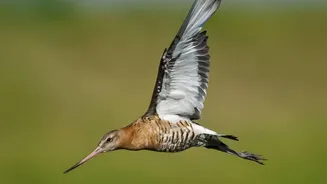
The Global Bird Superhighways
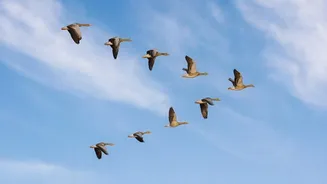
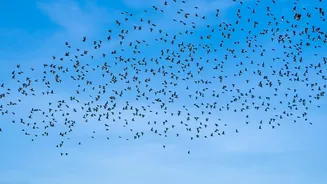
Twice a year, billions of birds undertake marathon journeys, flying along established paths known as flyways. These are not random flights; they are aerial superhighways connecting breeding grounds in the north with wintering areas in the south. One of the most
significant of these is the Central Asian Flyway (CAF), a vast route stretching from Siberia to the Indian Ocean, encompassing 30 countries. India sits at the very heart of this flyway, making it an indispensable resting and feeding ground for hundreds of species, from majestic cranes to tiny warblers. These routes, used for millennia, are now facing unprecedented threats.
Uncovering the Hidden Fragility
A comprehensive new global assessment has revealed the hidden vulnerability of these migrations: their reliance on a small number of critical 'stopover' sites. Think of these sites as essential service stations on a highway. They are wetlands, forests, and grasslands where birds must rest and refuel. Some species need to double their body weight to gather enough energy for the next leg of their journey. The recent review, published in Nature Reviews Biodiversity, found that 51% of migratory bird species are declining globally. The core problem is that the loss of even a few of these vital stopover sites can have a catastrophic impact on an entire population, as it breaks a critical link in the chain of their journey.
The Weakest Links in the Chain
The primary threats identified by scientists are habitat loss from agriculture and development, climate change, and pollution. A wetland drained for farming, a coastal mudflat replaced by a port, or a forest cleared for urban expansion can spell disaster. These stopover habitats are shrinking and becoming degraded, forcing birds to fly further in an exhausted state, often without finding the resources they need to survive. Climate change adds another layer of danger, causing extreme weather events and altering the timing of food availability, creating a mismatch between when birds arrive and when their food sources are abundant.
India's Crucial Role and Responsibility
Given its strategic location on the Central Asian Flyway, India plays a pivotal role in the survival of these global travelers. Many of the country's wetlands, grasslands, and coastal areas serve as irreplaceable wintering and stopover habitats. Recognizing this, India has launched a National Action Plan for the conservation of migratory birds along the flyway. In February 2024, at the 14th Conference of the Parties to the Convention on the Conservation of Migratory Species (CMS), India's initiative to establish a formal conservation program for the CAF was adopted, creating an institutional framework for all 30 range states. This marks a significant step, as conservation efforts within one country are futile if the habitats in another are destroyed.
Conservation Without Borders
The study underscores a fundamental truth: migratory birds do not recognize political boundaries. A bird protected in its breeding grounds in Russia can still face extinction if its wintering habitat in India or a stopover site in between disappears. This makes international cooperation not just helpful, but essential. The new framework for the Central Asian Flyway is a model for this approach, aiming to coordinate conservation actions across nations. The survival of these species depends on a network of healthy ecosystems spanning continents, requiring a shared global commitment to protect these crucial links before more species are lost forever.