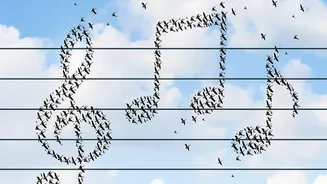








The Music of Survival
At its core, birdsong is a powerful tool for survival, not idle chatter. For about 4,000 species known as songbirds, these complex vocalisations serve two primary and urgent purposes: defending territory and attracting a mate. A male bird singing from
a high branch is sending a clear message to rivals: “This area is occupied and I am strong enough to defend it.” A loud, intricate song signals health and vitality, warning away competitors and reducing the need for physical conflict. Simultaneously, this same performance is a serenade aimed at potential partners. Females can judge the fitness of a male by the quality and complexity of his song, looking for clues about his age, health, and suitability as a father. It’s less of a discussion and more of a high-stakes broadcast of personal credentials.
The Grammar of Song
While not a conversation, birdsong is far from simple. It has a distinct and often rule-based structure. Researchers use terms from linguistics, like phonology and syntax, to describe the patterns. Birds produce individual notes, or syllables, which they arrange into specific sequences to form phrases and full songs. Some species have a very simple, repetitive song, while others, like the Brown Thrasher, can have a repertoire of over 2,000 different songs. Young songbirds don’t know their songs instinctively; they learn by listening to and imitating adults, much like human infants learn to speak. This can even lead to regional dialects, where birds of the same species in different areas have audibly different songs. The complexity comes from arranging these learned sounds, not from a back-and-forth exchange of new ideas.
Broadcast, Not Dialogue
The key difference between birdsong and human conversation lies in intent and interaction. A conversation involves turn-taking, shared context, and the ability to respond to new information with novel replies. While birds do communicate, their songs are generally pre-set performances. A singing bird isn't typically waiting for a direct, content-based reply to its specific melodic phrase; it’s advertising its status. Recent research shows that for many birds, like the zebra finch, the subtle acoustic texture and quality of the notes are more important than the order in which they are sung. This is the opposite of human language, where changing the sequence of words drastically alters the meaning. While some bird calls have specific meanings—like an alarm call for a predator—the elaborate songs are more akin to a repeated, beautiful, and highly informative advertisement.
Intriguing Parallels and New Discoveries
The line between structured sound and language-like properties continues to be a hotbed of research. Scientists have found fascinating parallels, such as birds appearing to follow a linguistic rule known as Zipf's Law of Abbreviation, where more frequently used notes or phrases tend to be shorter—much like we shorten “television” to “TV”. Furthermore, some species, particularly in the tropics, do engage in duetting, where male-female pairs sing coordinated and alternating songs to strengthen their bond. Researchers are even using AI models, similar to those that power generative text, to better understand the rules of birdsong syntax. These models help confirm that bird vocalizations are highly structured, even if they lack the semantic depth of human language. These studies show that while birds may not be “talking,” they are engaging in one of the most complex forms of communication in the animal kingdom.