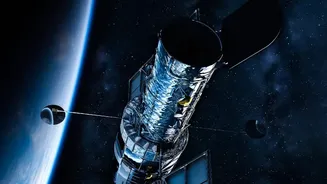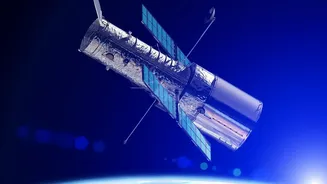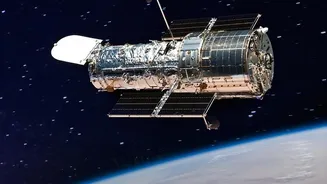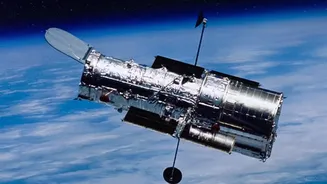

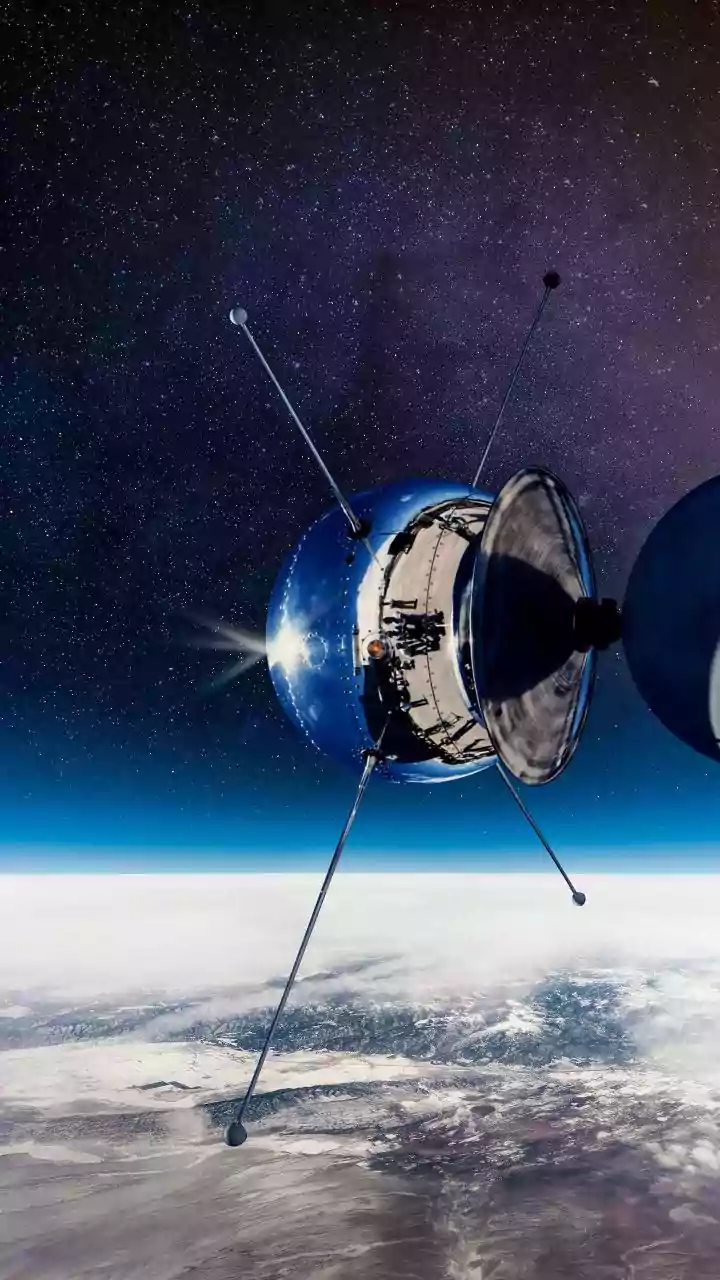





After nearly 22 years of unlocking cosmic secrets, NASA's legendary Neil Gehrels Swift Observatory took its final bow on November 4, plunging through Earth's atmosphere. Its end was not unwatched; a global network meticulously tracked its descent.
A Storied Mission's Final Chapter
Launched
in November 2004, the Swift Observatory was a game-changer in high-energy astrophysics. Its primary mission was to be the first responder for gamma-ray bursts (GRBs), the most powerful explosions in the universe. With its unique ability to rapidly pivot its three telescopes to a new target, often within a minute, Swift revolutionised our understanding of these fleeting events. It helped confirm that long GRBs come from collapsing massive stars, while short bursts originate from merging neutron stars. Far exceeding its planned two-year mission, Swift became a versatile cosmic observer, contributing to roughly 7,000 scientific papers on everything from supernovae to black holes.
The Inevitable Fall from Orbit
Like all satellites in low-Earth orbit, Swift was subject to the faint but persistent pull of atmospheric drag. In recent years, heightened solar activity from Solar Cycle 25, which peaked in 2025, caused Earth's upper atmosphere to expand. This increased the drag on Swift, accelerating its orbital decay. With no onboard propulsion to boost its altitude, its fall became inevitable. An ambitious commercial rescue mission by Katalyst Space, intended to grapple the observatory and push it to a higher orbit, unfortunately failed after the rescue craft, LINK, experienced technical problems shortly after its July 2026 launch. With its fate sealed, Swift's science operations concluded on October 20, 2026.
Enter the Guardians of the High Ground
Monitoring Swift's final journey was the U.S. Space Force's 18th Space Defense Squadron (18 SDS), based at Vandenberg Space Force Base, California. This specialised unit is responsible for Space Domain Awareness, which means keeping tabs on all artificial objects orbiting Earth. Their mission is critical for preventing collisions in space, ensuring the safety of human spaceflight, and predicting when and where objects will re-enter the atmosphere. Using a vast global network of sensors, the 18 SDS maintains the world's most comprehensive catalogue of space objects, sharing data with satellite operators and allies worldwide via the public website Space-Track.org.
A Network of Eyes on the Sky
The 18 SDS commands the Space Surveillance Network (SSN), a collection of around 30 ground_based radar and optical sensors spread across the globe. Radar is the primary tool for tracking objects in low_Earth orbit, capable of detecting items as small as a basketball thousands of miles away. For higher orbits, powerful optical telescopes like the Ground_based Electro_Optical Deep Space Surveillance (GEODSS) system watch for sunlight glinting off satellites against the night sky. By combining thousands of daily observations from these varied sensors, analysts at the 18 SDS build and constantly refine a precise orbital model for every tracked object, including the descending Swift.
Pinpointing the Final Plunge
Predicting the exact time and location of a re_entry is notoriously difficult until the final hours. An object in low_Earth orbit circles the globe in about 90 minutes, so even a small uncertainty in the re_entry time translates to thousands of kilometres of uncertainty on the ground. Factors like fluctuations in atmospheric density and the object's tumbling motion can alter its trajectory. The 18 SDS continuously processed data, issuing updated Tracking and Impact Prediction (TIP) messages that narrowed the re_entry window. In the end, their tracking was remarkably precise, confirming the final location and time of Swift's atmospheric interface.
A Safe and Fiery End
On November 4, 2026, the U.S. Space Force confirmed that the Swift Observatory re_entered the atmosphere at 7:39 a.m. EST. The final impact location was over the North Sumatra region of Indonesia. As predicted by NASA, the 1,450_kilogram spacecraft mostly burned up upon its fiery passage through the dense lower atmosphere. While it's possible some durable components made of tungsten or titanium survived the descent, the re_entry occurred over a sparsely populated area and no harm to people or property was reported. The risk of any surviving debris causing harm had been estimated by NASA as low, at approximately 1 in 2,100.