






An Illusion of Fire
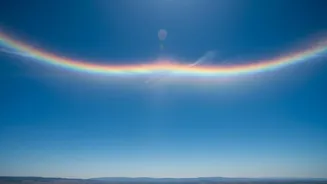
The image that recently caught the public’s eye was NASA’s Astronomy Picture of the Day for August 2, 2026, showing a vibrant splash of colour in the clouds over West Virginia. While the photo itself was taken in 2021, its selection by NASA has brought
this stunning phenomenon back into the spotlight. The term “fire rainbow” is evocative, but it is also a complete misnomer. The spectacle is neither fire nor a rainbow. Its proper scientific name is a circumhorizontal arc, and it belongs to a family of optical phenomena called ice halos. The nickname likely comes from its fiery, separated colours appearing in wispy cirrus clouds, sometimes giving the impression of flames in the sky. However, the mechanism is pure, cold physics, a trick of light and ice high in the atmosphere.
A Recipe for a Celestial Spectacle
Like any great natural display, a circumhorizontal arc requires a precise set of ingredients to form. The conditions are so specific that seeing one is considered quite rare. First, the sun must be very high in the sky, at an altitude of at least 58 degrees above the horizon. This is why the phenomenon is more common in the summer months in mid-latitude regions and virtually impossible to see in northern latitudes where the sun is always lower. Second, there must be high-altitude cirrus clouds. These thin, wispy clouds, found above 20,000 feet, are composed of tiny ice crystals rather than water droplets. Finally, the shape and orientation of these ice crystals are critical. They must be flat, hexagonal plates, and they need to be lying horizontally as they drift in the air, creating a collective prism effect.
Prisms in the Sky
The magic happens when sunlight enters the vertical side of one of these plate-like ice crystals and exits through the bottom horizontal face. The 90-degree angle between the entry and exit faces causes the light to refract, or bend, splitting the white sunlight into its constituent colours, much like a glass prism. When millions of these crystals are aligned correctly, they work together to create a vast, colourful band parallel to the horizon. This is fundamentally different from a true rainbow, which is formed by the refraction and reflection of light within spherical liquid water droplets from rain or mist. A classic rainbow is always seen in the part of the sky opposite the sun, whereas a circumhorizontal arc is always located below the sun.
A Family of Atmospheric Wonders
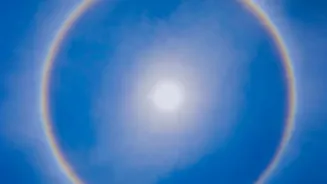
The circumhorizontal arc is just one member of a large and fascinating family of atmospheric optical effects created by ice crystals. Once you start looking, you might notice others. Perhaps the most common are “sun dogs,” also known as mock suns or parhelia. These are bright spots of light that appear about 22 degrees to the left and right of the sun, often on a faint ring called a 22-degree halo. Like circumhorizontal arcs, sun dogs are formed by light refracting through hexagonal ice crystals, but in this case, the crystals are not necessarily lying perfectly flat, and the phenomenon is most visible when the sun is low in the sky. You might also spot a sun pillar, which is a vertical shaft of light extending up from the rising or setting sun. This is caused by light reflecting off the surface of falling ice crystals.
How to Spot One
If you want to spot a circumhorizontal arc, your best bet is to look up during the middle of a summer day when the sun is at its highest point. Scan the sky for thin, feathery cirrus clouds. Because the arc forms below the sun, it can be easy to miss, so be sure to look in the area of the sky beneath it, but never look directly at the sun itself. While they are relatively rare, the increasing number of people with high-quality cameras in their pockets has led to more frequent sightings being shared online, helping to build public awareness of these beautiful sky shows. So the next time you see high, wispy clouds on a sunny day, take a moment to look closely. You never know what optical wonders might be hiding in plain sight.