



Earth's Overlooked Neighbor
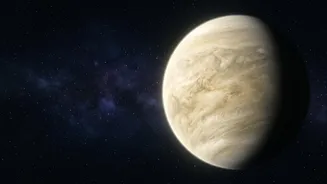
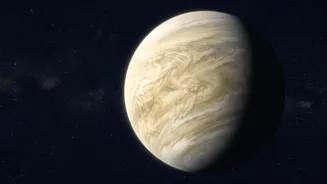
For decades, Venus has been the forgotten planet in our solar system's search for life. While missions flocked to Mars, seeking signs of ancient rivers and microbial fossils, Venus was largely written off as a planetary wasteland. With surface temperatures
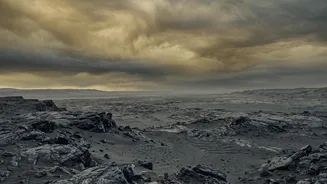
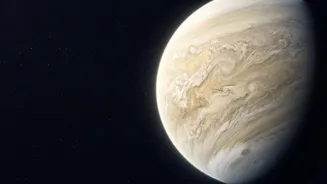
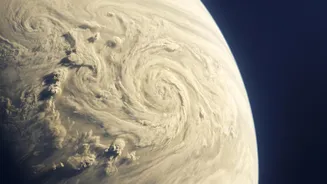
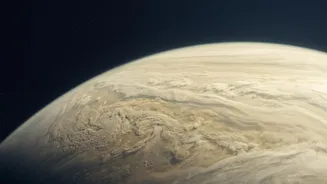
soaring to 462°C under a crushing atmosphere 92 times denser than Earth's, its reputation as a hellscape was well-earned. The planet's defining feature is a thick, perpetual blanket of clouds composed not of water, but of highly concentrated sulfuric acid. On Earth, such an environment would instantly destroy the complex molecules that form the basis of life. This led to a consensus that whatever story Venus had to tell, it wasn't one about biology. But science is persistent, and a surprising new chapter is being written—not on the scorched surface, but high within those corrosive clouds.
The Chemistry Before Life
To understand why Venus is back in the spotlight, we need to talk about prebiotic chemistry. This field of science isn't about finding little green aliens; it’s about understanding how life’s essential building blocks—molecules like amino acids and nucleotides—could have formed from simpler, non-living chemicals on a young planet. It’s the chemistry of the transition from geochemistry to biochemistry. Scientists studying the origin of life on Earth investigate how these crucial components could have survived and organized themselves in a primordial soup. For a long time, the search for these processes elsewhere has focused on worlds with liquid water, like Mars or the icy moons of Jupiter and Saturn. The fundamental assumption was that you need a relatively gentle, water-based environment. Venus, with its acid-bath clouds, seemed to violate every rule.
A Surprising Discovery in Acid
The game changed with recent laboratory experiments from researchers at MIT. They wanted to test a core assumption: that Venus's sulfuric acid clouds would automatically destroy any complex organic molecules. What they found was stunning. The team discovered that peptides—short chains of amino acids that are fundamental to proteins—can remain stable in nearly pure sulfuric acid for weeks. Even more importantly, they didn't just survive; they folded into stable, three-dimensional shapes. This is a crucial finding because a molecule's shape often dictates its function in biology. The reason for this unexpected stability seems to be the extreme lack of water. Chemical reactions that break down peptides often rely on water molecules, which are scarce in the highly concentrated acid, effectively preserving the peptides. This research doesn't prove there is life on Venus, but it shows that a key barrier to prebiotic chemistry might not exist after all.
Rethinking the Clouds of Venus
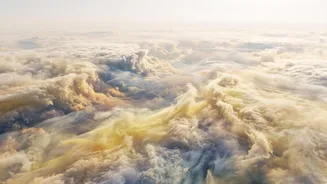
This breakthrough builds on a growing body of evidence that makes Venus's atmosphere an intriguing target. Between 48 and 60 kilometers high, temperatures and pressures are surprisingly Earth-like. This temperate zone has long been speculated as a potential haven for life. The idea gained mainstream attention in 2020 with the controversial, and still heavily debated, detection of phosphine gas in the atmosphere—a molecule that on Earth is predominantly associated with living organisms. While the phosphine signal remains contested, it sparked a wave of new research. Scientists are now considering whether Venus's clouds could act as a giant natural laboratory. Even if life never arose there, the unique chemical environment could provide invaluable clues about the kinds of prebiotic pathways that are possible in the universe, far beyond the water-based chemistry we know on Earth.
A New Frontier in an Old Place
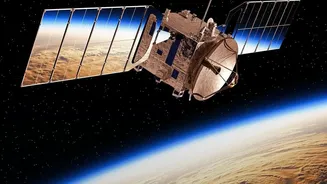
The focus is now shifting to what other complex molecules might survive in these conditions. Previous work had already shown that amino acids and the components of DNA could remain intact in concentrated sulfuric acid. This new understanding that peptides can also fold and hold their structure opens up a whole new range of possibilities for complex chemistry. Some models even explore the theory of panspermia, suggesting that microbes from Earth could have been blasted into space by asteroid impacts and reached Venus, potentially seeding its cloud layers. While still a hypothesis, it highlights how interconnected our corner of the solar system might be. The renewed interest is driving a new era of exploration, with upcoming public and private missions planning to plunge probes directly into Venus's atmosphere to analyze its composition up close.