





A Moon with Its Own Light Show
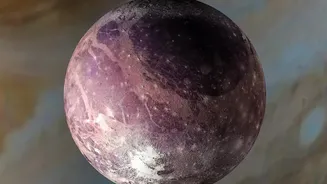
Ganymede is unique in our solar system. Not only is it the largest moon, bigger than the planet Mercury, it is the only moon known to have its own magnetic field. This magnetic field is strong enough to generate auroras—shimmering ribbons of hot, electrified
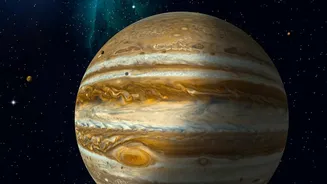
gas that circle its north and south poles. These are similar to Earth's own northern and southern lights. However, Ganymede's situation is more complex. Its own magnetic field is nestled inside the immensely powerful magnetic field of its parent planet, Jupiter. This cosmic tug-of-war is the key to the whole discovery.
The Tell-Tale 'Rocking' Motion
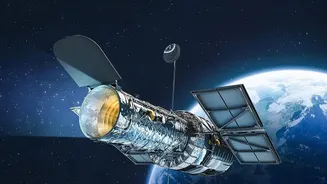
As Jupiter rotates, its magnetic field shifts and pulls on Ganymede's field. Scientists predicted that this interaction should cause Ganymede's auroral belts to rock back and forth by about six degrees. A team of scientists, led by Joachim Saur at the University of Cologne in Germany, had a clever idea: what if they could use the Hubble Space Telescope to watch this rocking motion and learn something about the moon's interior? When they observed Ganymede in ultraviolet light, they saw the auroras, but something was off. Instead of the expected six-degree wobble, the auroras were only rocking by about two degrees. They were being suppressed by something inside the moon.
An Ocean as a Magnetic Brake
The most compelling explanation for this dampened rocking was a huge, global ocean of saltwater beneath the moon's icy crust. Salty water is an excellent electrical conductor. As Jupiter's magnetic field swept across Ganymede, it would induce a secondary, weaker magnetic field within this hidden ocean. This induced field would act as a powerful brake, pushing back against Jupiter's influence and dramatically reducing how much the auroras could rock back and forth. The data from Hubble perfectly matched the models of a moon with a subsurface ocean, providing the best evidence to date that such a feature exists.
More Water Than All of Earth
The implications of this discovery are staggering. Scientists estimate this subterranean ocean is about 100 kilometres thick, making it ten times deeper than Earth's oceans. It is buried under a 150-kilometre-thick shell of mostly ice. In total, this hidden sea on Ganymede is thought to contain more water than all of the surface water on Earth combined. While suspicions of an ocean on Ganymede date back decades, and NASA's Galileo mission provided initial hints in the 1990s and early 2000s, Hubble's sustained observation of the auroras offered the first truly decisive evidence.
Why This Hidden Ocean Matters
Finding liquid water is a critical step in the search for life beyond our planet. While the water on Ganymede is trapped far from the sun, the presence of a liquid ocean opens up fascinating possibilities. Some models suggest that this water might be in direct contact with a rocky seafloor, a condition that could provide the chemical ingredients necessary for life to emerge. The discovery marks a milestone in planetary science, demonstrating a creative new way to probe the interior of a distant world without ever landing on it. This ingenious method of using auroras as a diagnostic tool paves the way for studying other ocean worlds, both in our solar system and potentially on planets orbiting other stars.