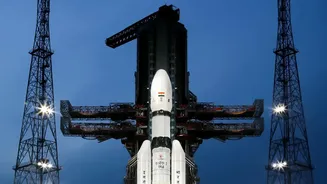




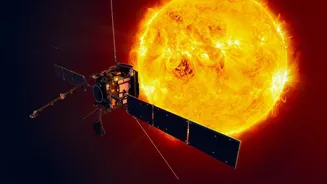
India's first solar observatory, Aditya-L1, is rewriting our understanding of the Sun's behaviour. By analysing a major solar eruption from August 2024, the mission has uncovered details that challenge long-held assumptions about these events.
A New Look at an Old Storm
On August
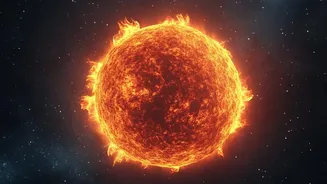
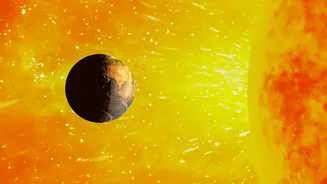
5, 2024, the Sun ejected a massive cloud of magnetised plasma, an event known as a Coronal Mass Ejection (CME). At the time, observatories tracked its progress, but the complete picture of its initial moments remained elusive. Now, months later, scientists from the Indian Institute of Astrophysics (IIA) in Bengaluru have revisited this event, using the unique capabilities of ISRO's Aditya-L1 mission to see it in a new light. Their findings, published in The Astrophysical Journal Letters, reveal that the eruption was far more complex than the simple, expanding 'bubble' often depicted in textbooks.
The Power of a Unique Perspective
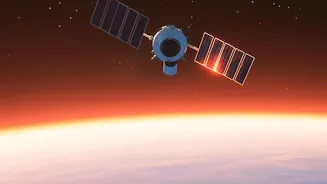
Positioned 1.5 million kilometres from Earth at Lagrange Point 1, Aditya-L1 has an uninterrupted view of the Sun. A key instrument onboard, the Visible Emission Line Coronagraph (VELC), is the source of this new discovery. While standard coronagraphs can take images of a CME moving across the sky, VELC does something more. It uses a technique called Doppler spectroscopy to measure how fast plasma is moving towards or away from the observer. This provides a crucial third dimension to the data, revealing the eruption's structure and movement in unprecedented detail. For the August 2024 event, VELC detected some material moving towards the observer while other parts moved away simultaneously, a clear sign of a complex, non-uniform expansion.
Challenging the 'Bubble' Theory
The common model for a CME is that of a symmetrical bubble expanding evenly in all directions. The data from Aditya-L1 challenges this idea directly. The IIA researchers found that a model assuming uniform expansion could not explain the spectral patterns recorded by VELC. However, when they created a 3D model that incorporated an uneven, tilted expansion, it closely matched the real-world observations. This discovery is significant; it shows that CMEs can be asymmetric, a detail that could dramatically influence how they travel through space and interact with the solar wind.
Why This Matters for Earth
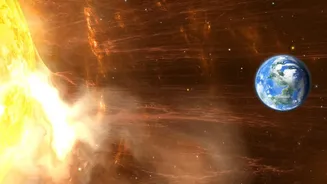
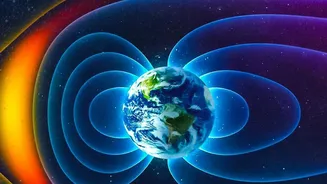
Understanding the true shape and behaviour of a CME is not just an academic exercise. CMEs that are directed towards Earth can trigger geomagnetic storms, which have the potential to disrupt our planet's magnetic field and damage critical infrastructure. These solar storms can interfere with satellites, knock out communication and GPS networks, and even cause widespread power-grid failures. By providing a more accurate picture of how these eruptions begin, Aditya_L1's findings can help scientists create better space weather forecast models. Knowing an eruption's true shape can lead to more precise predictions of its speed, trajectory, and potential impact on Earth, giving us a better chance to prepare and protect our technological systems.