






Introducing the SOLVE Rocket
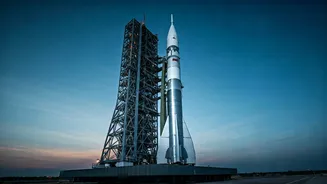
Meet SOLVE, which stands for Sub-Orbital Launch Vehicle for Experiments. Developed by ISRO, this is not a rocket designed to go into orbit. Instead, it is a dedicated test platform with a crucial role: ensuring the safety of future Indian astronauts.
Its main job is to carry a replica of the Gaganyaan crew module to a specific altitude and release it, allowing engineers to test the all-important landing systems. The development of this specialised vehicle is a significant milestone, providing a flexible and reliable way to conduct repeated tests under various conditions, something essential for human-rated missions.
A Purpose-Built Machine
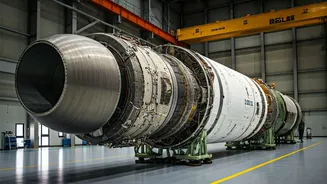
To build SOLVE, ISRO engineers cleverly adapted existing technology. The rocket's solid propulsion stage is derived from the powerful strap-on boosters used on India's workhorse rocket, the Polar Satellite Launch Vehicle (PSLV). However, it has been significantly modified for its new mission. These changes include a slower-burning propellant and a straight nozzle with a secondary injection thrust vector control system. In simple terms, this means the rocket is designed to fly more gently and with greater control, allowing engineers to perfectly simulate the conditions needed to test the crew module's parachute system.
The 17-Kilometre Drop Test
The flight plan for SOLVE is precise and dramatic. The rocket will carry the Gaganyaan crew module to an altitude between 10 and 17 kilometres. At that height, it will separate from the module, which will then begin its descent. This is the moment of truth that SOLVE is designed to create. As the module falls, a complex, pre-programmed sequence of 10 different parachutes will deploy to systematically slow its speed. The ultimate goal is to ensure the module can splash down safely in the sea. This altitude range is not arbitrary; it is carefully chosen to test the parachute system under the specific atmospheric pressures and speeds it would encounter during a real return from orbit.
A Successful First Step
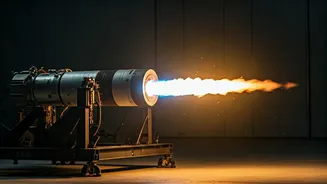
Before SOLVE can fly, its engine must be proven reliable on the ground. In early July 2026, ISRO successfully completed the first static ground test of the SOLVE solid motor at the Satish Dhawan Space Centre in Sriharikota. In a static test, the engine is fired at full power while securely bolted to a test stand, allowing engineers to measure its performance without a launch. ISRO confirmed the motor performed exactly as expected, marking a successful validation of the new design. This crucial ground test paves the way for the first actual flight test of the SOLVE rocket and the Gaganyaan parachute system.
The Big Picture for Gaganyaan
Every test, from ground firings to sub-orbital drops, is a critical part of the larger Gaganyaan mission. This programme aims to send a crew of Indian astronauts into low-Earth orbit on an Indian rocket and return them safely to Earth. Achieving this would make India only the fourth nation in the world to possess independent human spaceflight capability. The development of platforms like SOLVE highlights ISRO's meticulous and safety-first approach. By thoroughly testing each component, especially the astronaut recovery systems, India is steadily and safely building its path to the stars, reinforcing its position as a major global player in space exploration.