





A Journey for the History Books
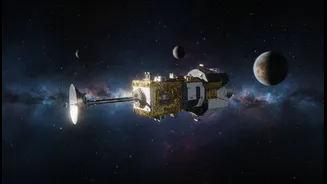
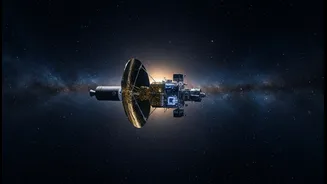
Launched in 2006, New Horizons was the fastest human-made object ever to leave Earth, embarking on a nine-year, three-billion-mile journey to Pluto. In July 2015, it made history, becoming the first spacecraft to perform a close-up study of the dwarf
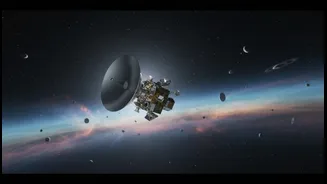
planet. The data it sent back revolutionised our understanding of that distant world, revealing active glaciers made of nitrogen ice, a layered atmosphere, and even hints of a subsurface ocean. But for New Horizons, Pluto was just the beginning. After that landmark encounter, the probe continued deeper into the Kuiper Belt, a vast, doughnut-shaped ring of icy bodies left over from the formation of the solar system. In 2019, it flew by Arrokoth, the most distant and primitive object ever explored by a spacecraft, giving scientists an unprecedented look at a building block of planets.
Awake and Active in Deep Space
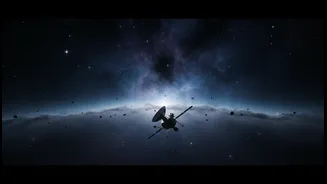
In early July 2026, after a resource-saving hibernation that lasted 321 days, NASA confirmed that New Horizons had once again awakened. Now nearly six billion miles (about 9.5 billion kilometres) from Earth, the probe is in excellent health and has resumed its scientific mission. This phase of its journey is less about visiting specific objects and more about serving as a unique deep-space observatory. It is currently collecting uninterrupted data on the environment of the Kuiper Belt, a region no other active mission is exploring. This includes measuring the plasma of the outer heliosphere—the vast bubble created by the Sun's stream of charged particles—and monitoring the cosmic dust environment.
How Is Communication Even Possible?
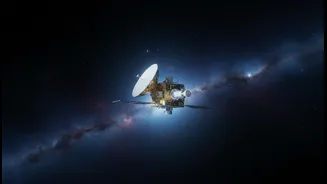
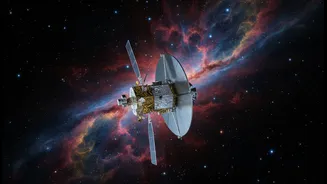
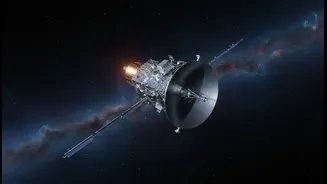
Communicating across such an immense distance is a monumental feat of engineering. A signal from New Horizons, traveling at the speed of light, now takes nearly nine hours to reach Earth. The probe uses its large, 2.1-metre high-gain antenna to send a focused X-band radio signal toward our planet. That signal, which is incredibly faint by the time it arrives, is captured by the massive 70-metre dishes of NASA's Deep Space Network, a trio of tracking stations located in Spain, Australia, and the United States. Because of the distance, the data rate is slow—around 1 kilobit per second, far slower than old dial-up internet. This is why it took 16 months to download all the data from the Pluto flyby. The spacecraft stores its findings on an 8-gigabyte solid-state recorder and transmits the information back to Earth over long periods.
A Power Source Built to Last
Far from the Sun, solar panels are useless. New Horizons relies on a Radioisotope Thermoelectric Generator (RTG), a space-proven power source that converts heat from the natural decay of plutonium-238 into electricity. This single RTG provided about 250 watts of power at launch, which has slowly decreased over time. By managing its power carefully, often through long hibernation periods, the mission team has conserved enough energy to keep the probe and its key instruments running. While the RTG's output will continue to decline, engineers expect New Horizons to remain operational into the late 2020s and possibly beyond, following in the footsteps of the legendary Voyager probes.
The Science on the Solar System's Edge
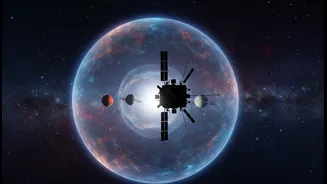
The data New Horizons is collecting now is priceless. It's helping scientists map the very edge of the Sun's influence, known as the heliosphere. Recent findings show that the solar wind—the stream of particles from the Sun—slows down as it collides with interstellar atoms at the fringes of our system. These observations provide a vital link between what the Voyager probes measured after they crossed into interstellar space and what we see closer to home. The probe's Alice ultraviolet spectrograph will soon begin observing the distribution of hydrogen gas in the outer heliosphere, while other instruments continue to measure charged particles and dust, painting a clearer picture of the boundary between our solar system and the vast galaxy beyond.