


A Tale of Two Sister Planets
Venus and Earth are often referred to as sister planets, and for good reason. They are similar in size, mass, and composition, suggesting they were forged from the same cosmic materials. Yet, for all their similarities, they couldn't be more different.
Earth is a vibrant world teeming with life, while Venus is a hellscape with a crushing atmosphere and surface temperatures hot enough to melt lead. One of the most striking differences, however, is that Earth has a large, stabilising moon, while Venus has none. This lunar absence has long been a major puzzle for planetary scientists trying to piece together the history of our solar system.
The Case of the Missing Moon
For years, scientists have proposed various theories to explain Venus's solitude. Perhaps the planet never experienced the type of giant, debris-flinging impact that is thought to have created Earth's Moon. Another popular idea was that if Venus did have a moon, a later catastrophic collision with a massive asteroid or comet could have obliterated it. But according to new research from astrophysicist Stephen Kane at the University of California, Riverside, the answer might not require a dramatic one-off catastrophe. Instead, the culprit may have been Venus's own fundamental nature.
A New Theory Born from Simulations
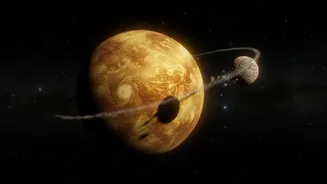
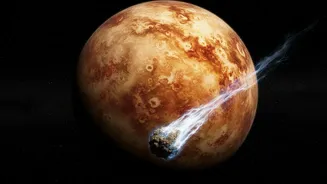
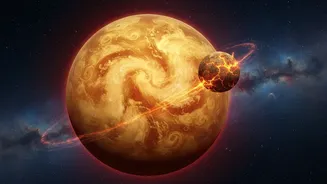
A study published in The Astrophysical Journal proposes a new, elegant explanation: Venus likely destroyed its own moon. Using sophisticated computer models, Kane and his team simulated what would happen to a hypothetical moon orbiting Venus. They found that the planet's exceptionally slow rotation would have created a fatal gravitational relationship with its satellite. The models showed that, unlike our own Moon which is slowly drifting away, a Venusian moon would have been doomed to spiral inwards.
The Slow, Inevitable Death Spiral
The physics behind this process is all about tidal forces and rotational energy. Earth rotates relatively quickly, once every 24 hours. This rapid spin transfers rotational energy to the Moon, pushing it farther away at a rate of about four centimetres per year. Venus is the complete opposite. It takes a staggering 243 Earth days for Venus to complete a single rotation—slower than its 225-day orbit around the Sun. This sluggish spin means there is no energy to push a moon away. Instead, the planet's immense gravity would dominate, relentlessly pulling the satellite closer and closer in a process known as tidal evolution. The moon's orbit would decay over millions of years, sending it on a collision course with its parent planet.
What the Computer Models Revealed
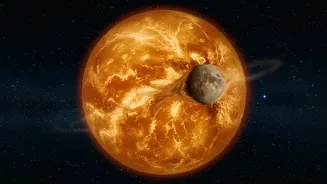
To test this, the researchers ran simulations with hypothetical moons of various sizes. The results were shockingly consistent. In almost every scenario, the moon's orbit decayed until it either crashed directly into Venus or was torn apart by the planet's gravity once it crossed a boundary known as the Roche limit, with the debris raining down onto the surface. The simulations suggest that this process would have happened relatively quickly in cosmic terms, with any moon being destroyed within the first billion years of the planet's history. This provides a tidy explanation that doesn't rely on a second, random catastrophic event. The conditions for the moon's destruction were built into the planet itself.
A Violent Past, A Moonless Present
The impact of a moon-sized object would have been cataclysmic, releasing an enormous amount of energy. Such an event could have profoundly altered Venus's geology and atmosphere, potentially contributing to the runaway greenhouse effect that makes the planet so inhospitable today. While the simulations don't prove Venus definitely had a moon, they show that the planet is unlikely to have kept one if it did. This research not only helps solve a long-standing mystery about our celestial neighbour but also has implications for understanding exoplanets. Slowly rotating rocky planets in other solar systems may also be unable to retain large moons, a factor that could influence their stability and potential for hosting life.