

A Powerful New Eye on the Cosmos
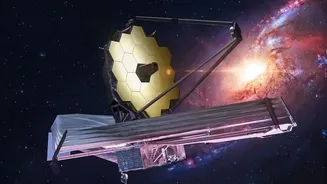
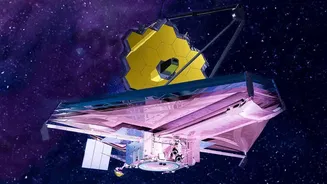
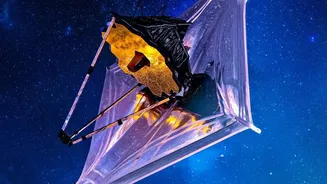
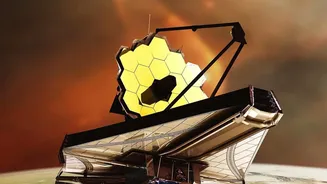
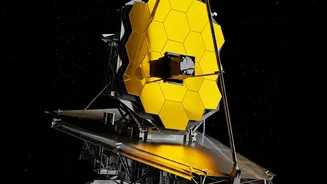
The "new space telescope" at the forefront of this investigation is NASA's James Webb Space Telescope (JWST). While not the only tool, its unprecedented infrared sensitivity allows it to peer into these distant atmospheres with stunning clarity. When
an exoplanet passes in front of its host star, JWST can analyze the starlight that filters through the planet's atmosphere. This method, known as transmission spectroscopy, allows scientists to read the chemical fingerprints left behind by different atoms and molecules, revealing secrets about the planet's composition and climate. This capability is a massive leap beyond previous observatories, which were often stumped by pervasive haze.
The Great Cosmic Veil
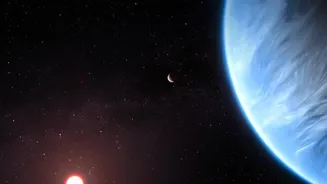
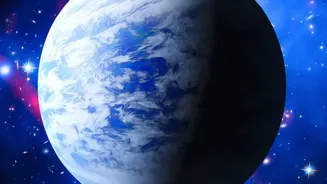
For astronomers, the cloudiness of many exoplanets has been a significant hurdle. These clouds and hazes are often so thick that they create a frustratingly blank, featureless signal when telescopes try to analyze the atmosphere beneath. This atmospheric veil obscures the very molecules—like water, methane, and carbon dioxide—that could hint at a planet's potential for hosting life. Understanding what these clouds are made of and how they behave is therefore not just a matter of curiosity; it's a critical step in refining the search for habitable worlds. Until we can see through the haze, or at least understand it, determining the true nature of these planets remains a challenge.
Clouds of Sand, Salt, and Smog
Unlike the water-based clouds of Earth, the clouds on distant exoplanets are far more exotic. Recent discoveries from JWST have confirmed what scientists had long suspected: these are not your everyday clouds. On some “hot Jupiter” exoplanets, where temperatures can soar high enough to vaporize rock, JWST has detected clouds made of silicate particles—essentially, microscopic grains of sand. On one such world, WASP-107b, scientists observed a dynamic cycle where silicate vapor rises, condenses into sand clouds, and then rains back down into the scorching lower atmosphere to vaporize again. On another world, the famous "Pink Planet," JWST even found evidence of clouds made of salt. Other atmospheres may be choked with photochemical haze, a type of smog formed when stellar radiation breaks down gases like methane.
Weather Forecasts for Other Worlds
One of JWST's most remarkable achievements is its ability to map the weather on these alien worlds. By observing a planet as it transits its star, scientists can separately analyze the light passing through its "morning" and "evening" sides. On the exoplanet WASP-94A b, this technique revealed a dramatic daily weather cycle. The planet's cooler morning side was found to be heavily shrouded in thick mineral clouds, while its hotter evening side was comparatively clear, showing strong signatures of water vapor. This discovery suggests a dynamic process where clouds form on the planet's cooler night side, circulate into the morning, and then burn off as they rotate into the intense heat of the day side. It's the first time such a repeating cloud cycle has been documented on a hot Jupiter.
Looking Ahead Through the Fog
The work being done by JWST is paving the way for future missions specifically designed to survey exoplanet atmospheres on a massive scale. The European Space Agency's Ariel space telescope, scheduled for launch around 2029, will dedicate its mission to studying the composition of about 1,000 exoplanet atmospheres. By building a large-scale survey of what alien skies are made of, scientists hope to answer fundamental questions about how planets form and evolve. Ariel, working in tandem with JWST, will help create a comprehensive catalog of planetary climates, distinguishing hazy, inhospitable worlds from those with clearer skies that might be more promising in the search for life.