


The Return of a Ghostly Phenomenon
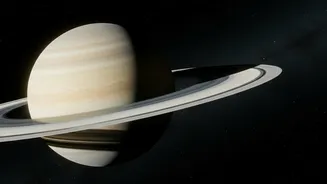
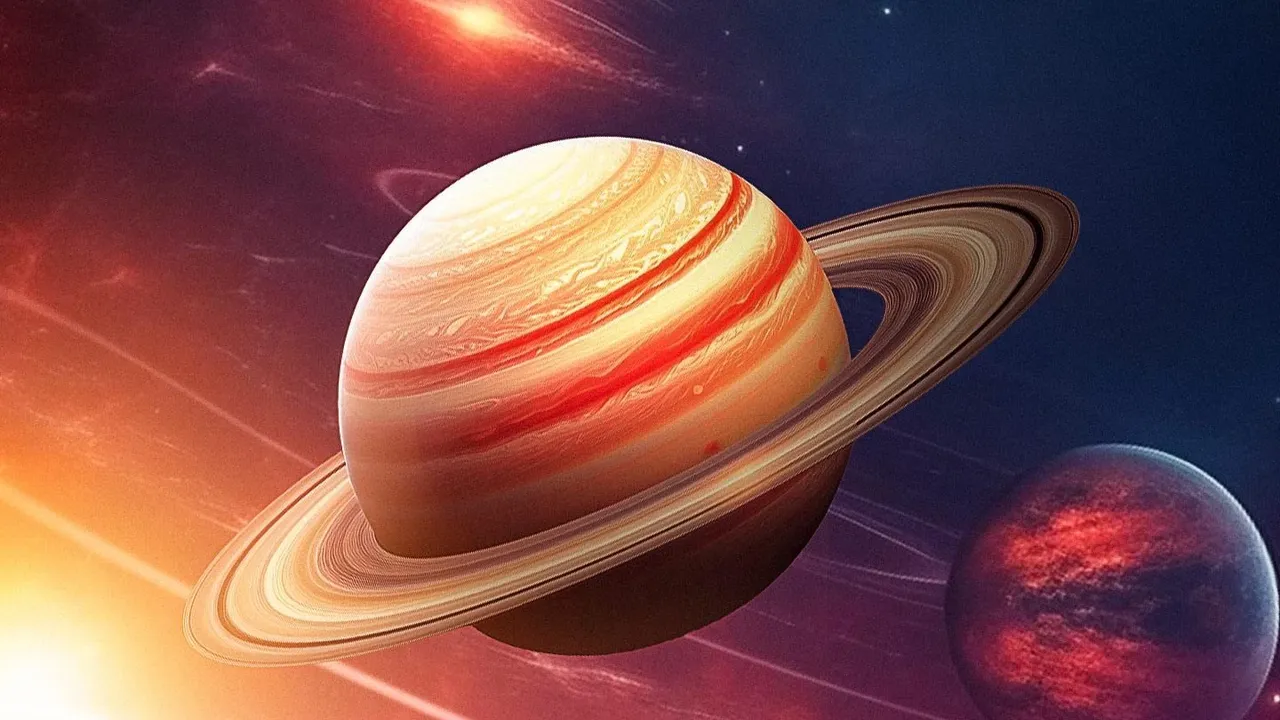
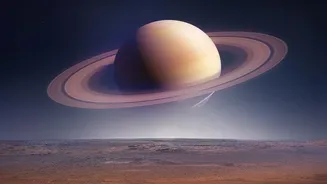
Imagine looking at Saturn's iconic rings and seeing faint, dark smudges stretching across them, like ghostly apparitions. These are not permanent fixtures but temporary features known as 'spokes'. First spotted by the Voyager probes in the 1980s, these
enigmatic markings have puzzled scientists for decades. They can appear and vanish in a matter of hours, rotating with the rings before fading away. Now, thanks to new images captured by NASA's Hubble Space Telescope, scientists have confirmed that 'spoke season' is officially underway again, providing an unprecedented opportunity to study them as they re-emerge from a long absence.
A Seasonal Spectacle
The appearance of Saturn's spokes is a seasonal event. Much like Earth, Saturn is tilted on its axis and experiences four seasons. However, with Saturn taking nearly 30 Earth years to orbit the Sun, each season lasts for about seven of our years. The spokes tend to vanish during Saturn's summer and winter solstices but become most active and visible around its equinoxes. This is the period when the planet’s rings are tilted edge-on to the Sun. Saturn's next equinox is approaching on May 6, 2025, and as it gets closer, spoke activity is expected to ramp up, with more frequent and darker spokes appearing. These features can be enormous; while they look small against the giant planet, a single spoke can be longer and wider than the entire diameter of Earth.
The Leading Theory: A Magnetic Connection
So, what causes these transient streaks? While no theory is perfectly confirmed, the leading hypothesis points to a dynamic interplay between Saturn's powerful magnetic field and the solar wind—a stream of charged particles flowing from the Sun. Scientists believe that during the equinox season, the solar wind batters Saturn's magnetic field more intensely. This interaction can generate electrostatic forces that charge tiny, dust-sized ice particles within the rings. Once charged, these fine particles are temporarily levitated above the main, flat plane of the rings, creating a visible, cloud-like feature that we see as a spoke. Depending on the viewing angle and lighting, these levitated clouds of dust can appear either dark or bright.
What New Hubble Images Reveal
The latest images from Hubble are crucial because they offer a continuous, long-term view that wasn't possible before. While the Cassini spacecraft orbited Saturn during its last equinox in 2009, its mission ended in 2017. This left a gap in observations. Now, Hubble's Outer Planet Atmospheres Legacy (OPAL) program is dedicated to monitoring the outer planets annually. This programme provides scientists with a consistent stream of high-quality data, allowing them to watch the entire spoke season unfold from beginning to end. According to Amy Simon, the lead scientist for the OPAL program at NASA, this extended observation period is the best chance yet to solve the mystery. By combining new Hubble data with archived observations from Cassini and Voyager, researchers can test their models and hopefully confirm what triggers the spokes and why they behave so predictably with the seasons.
A Natural Laboratory for Planetary Science
Studying Saturn's spokes is more than just solving a cosmic curiosity. These features provide a natural laboratory for understanding planetary physics that is impossible to replicate on Earth. The phenomenon gives scientists a chance to observe the complex interactions between a planet's magnetosphere, its rings, and solar radiation in real time. Understanding how these forces charge and move dust can provide insights into the early formation of planetary systems, where similar processes played a role in building planets from dusty disks. Each new image brings another piece of the puzzle into focus, deepening our understanding of the dynamic and ever-changing nature of our own solar system.