



A Mission That Keeps on Giving
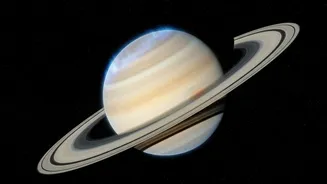
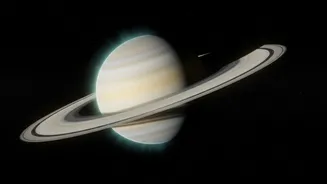
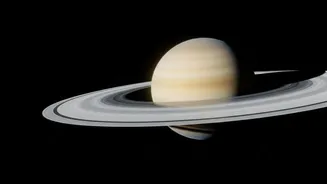
The Cassini-Huygens mission, a joint effort between NASA and European space agencies, was one of history's most successful planetary explorations. From 2004 to 2017, the orbiter gathered an unprecedented volume of information about Saturn, its famous
rings, and its fascinating collection of moons. Discoveries ranged from liquid methane seas on Titan to a global subsurface ocean on the icy moon Enceladus. When the mission concluded with a dramatic final dive, it left behind a treasure trove of data. Scientists knew it would take decades to fully analyze, and recent findings prove just how much was left to discover.
The Planetary Force Field
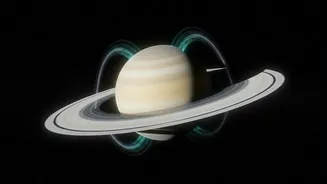
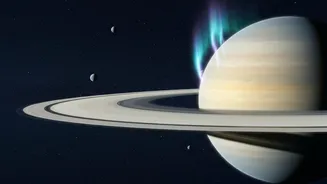
To understand the latest discovery, it helps to know what a magnetosphere is. Think of it as a planet's protective bubble, a magnetic shield that deflects the solar wind—a constant stream of charged particles flowing from the sun. Earth's magnetosphere is shaped mostly by this solar wind, creating a relatively symmetrical structure. However, this shield isn't perfect. Near the poles are funnel-like openings called cusps, where solar particles can leak into the atmosphere, creating auroras. On Earth, this cusp is reliably located on the 'noon' side of the planet, the point directly facing the sun. For years, scientists worked with the assumption that other planets, while different in scale, would follow similar rules.
Saturn's Lopsided Shield
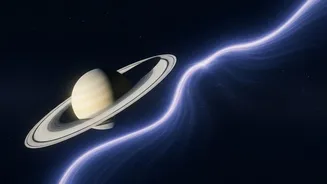
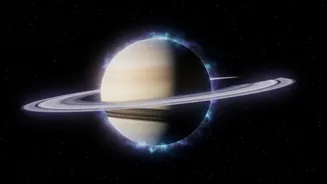
A new analysis of Cassini data has turned that assumption on its head. By studying observations collected between 2004 and 2010, researchers found that Saturn's magnetic cusp is not where it's supposed to be. Instead of being at the 12 o'clock position (high noon), it is significantly dragged toward the 'dusk' or afternoon side of the planet. On average, the cusp is located between 1 and 3 o'clock local time, and has sometimes been observed as late as 8 o'clock in the evening. This finding proves Saturn's magnetosphere is not just a larger version of Earth's; it operates under a fundamentally different set of rules.
An Engine of Its Own Making
So what is causing this dramatic skew? The answer lies not with the external solar wind, but with Saturn's own powerful internal dynamics. The new research confirms a long-held theory that for gas giants, the planet itself is the dominant force. Two key factors are at play. First, Saturn spins incredibly fast, completing a day in just 10.7 hours. Second, it drags a heavy soup of plasma around with it. Much of this material comes from its geologically active moon, Enceladus, which constantly sprays plumes of water vapor and ice from its subsurface ocean into space. This material becomes ionized and gets caught in the planet's rapid rotation, effectively dragging the entire magnetic field with it and pulling the cusp far into the afternoon.
Solving One Mystery, Highlighting Another
This lopsided structure has major implications for understanding the planet's brilliant auroras and the explosive acceleration of high-energy particles in its vicinity. It also provides crucial information for planning future missions to explore potentially life-harboring moons like Enceladus. But as Cassini's data solves one puzzle, it sharpens another. During its final orbits, the spacecraft confirmed that Saturn's magnetic field is almost perfectly aligned with its rotational axis, with a tilt of less than one-hundredth of a degree. According to our current understanding of planetary physics, a field this perfectly aligned shouldn't be able to sustain itself. The ghost of Cassini continues to challenge our models of how planets work.