






A 150-Year-Old Question
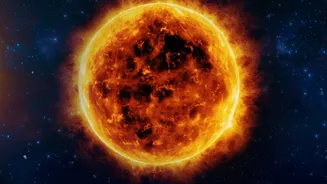
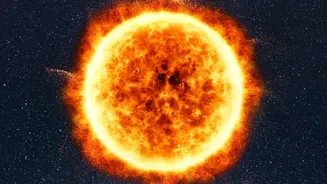
Imagine standing by a campfire. The closer you get, the hotter it is. Move away, and it gets cooler. This is common sense, governed by the laws of thermodynamics. The sun, however, seems to break this rule. Its visible surface, the photosphere, burns
at a blistering 5,500 degrees Celsius. But its outer atmosphere, the corona, which extends millions of kilometres into space, soars to temperatures of over a million degrees. This baffling phenomenon is known as the coronal heating problem, and it has puzzled astrophysicists for generations. Adding to the complexity was a prediction made around 1870 by scientists Lord Kelvin and Hermann von Helmholtz. They theorised that when two fluids moving at different speeds slide past each other, they create a 'shear' that results in spiralling vortices, much like wind creating waves on the ocean. Scientists long suspected this phenomenon, known as the Kelvin-Helmholtz Instability (KHI), might play a role on the sun, but they could never prove it.
A New Eye on Our Star
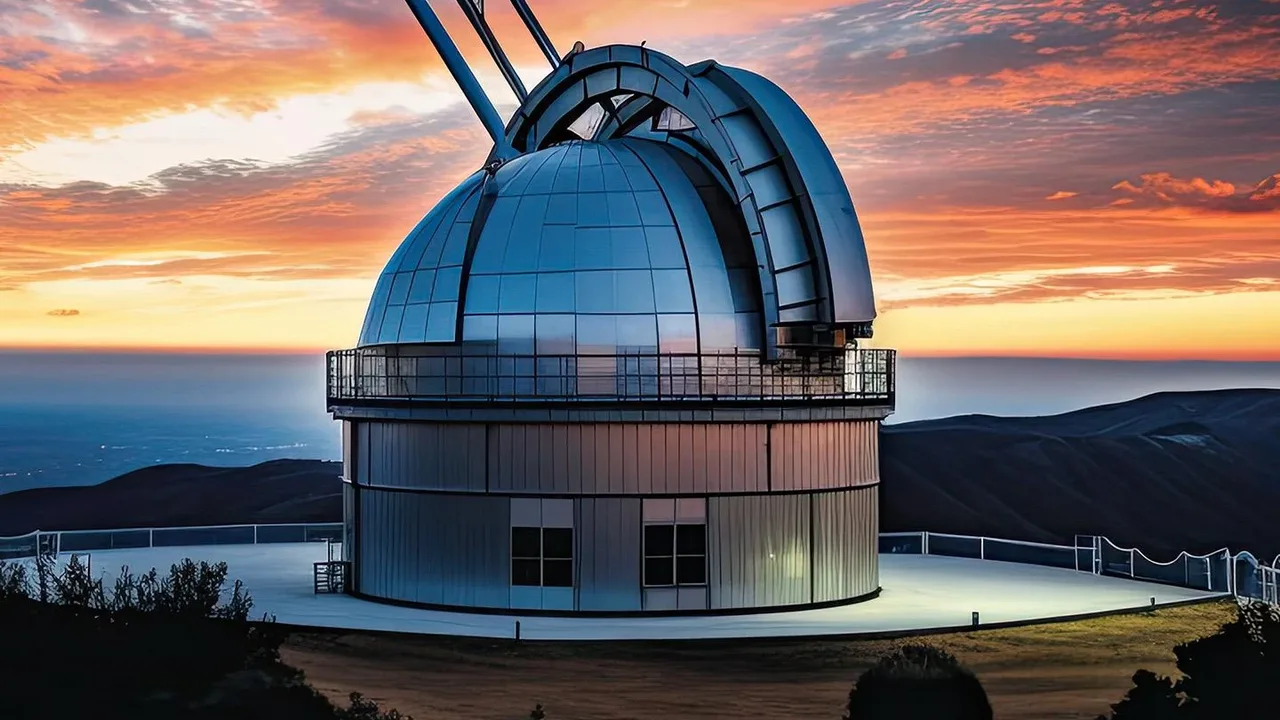
The key to solving this century-and-a-half-old puzzle is the Daniel K. Inouye Solar Telescope. Perched atop the Haleakalā volcano on Maui, Hawaii, it is the most powerful solar telescope on Earth. With a massive four-metre primary mirror, it can collect unprecedented amounts of light, allowing it to see the sun in astonishing detail. The telescope is capable of resolving features on the sun's surface as small as 20 kilometres across. This is an incredible feat of engineering, akin to spotting a small coin in Delhi from a vantage point in Mumbai. This power allows scientists to observe the fine, intricate dance of plasma and magnetic fields on the solar surface that were previously just a blur. It was this revolutionary capability that finally allowed researchers to hunt for the elusive Kelvin-Helmholtz vortices.
The 'Gotcha' Moment
In images released in August 2026, scientists announced they had finally found what they were looking for. The Inouye Telescope's ultra-high-resolution images of the photosphere revealed tiny, whirlpool-like patterns swirling at the edges of the sun’s magnetic regions. These were the tell-tale fingerprints of the Kelvin-Helmholtz Instability, seen for the first time on the sun's visible surface. Researchers were reportedly 'blown away' by the images, which showed these vortex-like structures curling, growing, and disappearing. The observations were a perfect match for advanced computer simulations of what KHI should look like on the sun, confirming their discovery. The images showed that these vortices are not rare, but a common feature, constantly churning where plasma flows at different speeds.
Why These Tiny Swirls Matter
Confirming a 150-year-old prediction is a major scientific achievement, but the implications go far beyond that. The discovery of these vortices provides a crucial new piece of the coronal heating puzzle. Scientists believe that these instabilities are a key mechanism for transporting energy from the sun's turbulent surface up into its atmosphere. The constant swirling and mixing action could be one of the engines that dumps vast amounts of energy into the corona, heating it to its extreme temperatures. Understanding this energy transfer is not just an academic exercise. This same process drives solar flares and coronal mass ejections—massive bursts of energy and particles that can hurl towards Earth. These events, collectively known as space weather, can disrupt satellites, damage power grids, and endanger astronauts. By better understanding the fundamental physics of the sun, we can improve our ability to predict these potentially damaging events.