


What is the Barnes Ice Cap?
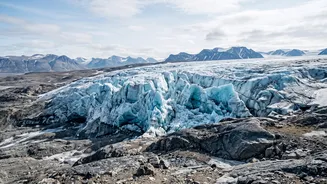
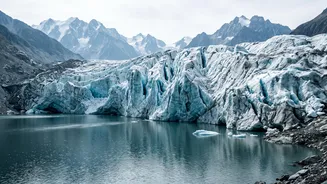
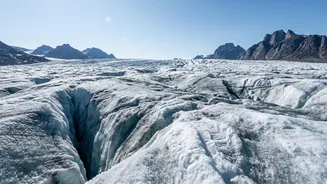
Located in the centre of Baffin Island in Nunavut, Canada, the Barnes Ice Cap is a bowling-pin-shaped mass of ice covering an area of approximately 5,700 square kilometres. While that sounds vast, it is merely a fragment of its ancient parent. The ice reaches
a thickness of up to 730 meters in some places, and its oldest layers date back more than 20,000 years, making it home to some of the most ancient ice in Canada. For most of the year, it's a landscape of white snow over ancient ice, but its significance lies not just in its size, but in its incredible history as the last true piece of a bygone geological era.
The Giant It Came From
The Barnes Ice Cap is the last surviving remnant of the massive Laurentide Ice Sheet. During the last glacial period, which peaked around 20,000 years ago, the Laurentide was a continent-spanning behemoth. It covered most of Canada and a large part of the northern United States, stretching from the Arctic Circle down to areas like modern-day Chicago and New York City. In some places, particularly over what is now Hudson Bay, the ice was an astonishing three to four kilometres thick. This colossal sheet of ice was so heavy and powerful that it carved out the Great Lakes and shaped much of the landscape of North America as we know it today. As the Earth's climate warmed around 14,000 years ago, this giant began its long retreat, eventually leaving behind only a few isolated remnants, with the Barnes Ice Cap being the most prominent survivor.
A Frozen Time Capsule
Scientists view the ice cap as a priceless archive of Earth's climate history. Because the Barnes Ice Cap is frozen to the bedrock beneath it, it doesn't slide like most glaciers. This unique characteristic means that ancient mosses and plants have been preserved underneath it, entombed as the ice expanded thousands of years ago. By carbon-dating these preserved plants, researchers can create a precise timeline of the ice's advance and retreat. These studies have revealed a fascinating story: after shrinking to its smallest size around 3,000 years ago, the ice cap began to grow again about 2,000 years ago, a sign that Earth may have been naturally heading towards a new glacial period. This expansion continued until about 1960, when the trend abruptly reversed.
A Fading Relic in a Warming World
The story of the Barnes Ice Cap took a sharp turn in the mid-20th century. The slow, natural re-growth that had been occurring for two millennia stopped and then dramatically reversed. Since the 1960s, the ice cap has been in a state of rapid retreat, shedding ice at an accelerating pace. In recent summers, including in 2026, satellites have shown the ice cap losing its reflective snow cover earlier in the season than ever recorded. This exposes the darker glacier ice beneath, which absorbs more sunlight and speeds up melting even further. Scientists have observed that the rate of thinning has been alarming, with meltwater channels now carving deep into the ancient ice. Projections based on current warming trends suggest the Barnes Ice Cap is doomed and could disappear entirely within the next 300 years.