







India's Eye on the Sun
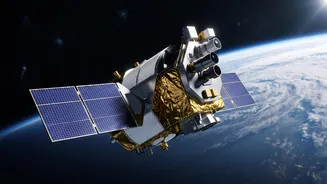
Launched in September 2023, Aditya-L1 is the nation's first space-based observatory dedicated to studying the Sun. After a journey of nearly four months, it settled into a special orbit called a halo orbit at Lagrange point 1 (L1), about 1.5 million kilometres
from Earth. This strategic position gives it an uninterrupted, continuous view of the Sun, free from the interference of Earth's atmosphere and magnetic field. Its primary goal is to observe the Sun's atmosphere, including the photosphere, chromosphere, and the outermost corona, to help scientists unravel the mysteries of solar activity like never before.
The Menace of Solar Flares
So, why stare at the Sun? A key reason is to understand solar flares. These are massive, sudden bursts of electromagnetic radiation from the Sun's surface. They occur when immense magnetic energy stored in the Sun's atmosphere is abruptly released. While they create beautiful auroras, large flares pose a significant threat. They can disrupt radio communications, damage satellites, interfere with GPS navigation, and endanger astronauts by increasing radiation levels in space. For our technology-dependent world, the ability to predict these events is not just a scientific curiosity; it's a critical necessity.
The Groundbreaking New Clues
Recent findings from Aditya-L1 have generated significant excitement. Scientists have identified small, short-lived brightenings in the Sun's atmosphere that appear in the hours before a major solar flare erupts. Crucially, these 'pre-flare transient events' tend to cluster around the very location where the larger flare eventually occurs. This is a huge clue. Some of these small brightenings also show X-ray signatures, confirming that they are tiny releases of magnetic energy. The theory is that these repeated, small-scale energy releases progressively destabilize the magnetic field in an active region, much like a series of small tremors before a large earthquake, ultimately triggering the main flare.
How Aditya-L1's Instruments Saw It
This discovery was made possible by the coordinated action of multiple instruments aboard Aditya-L1. The Solar Ultraviolet Imaging Telescope (SUIT) was instrumental, using its near-ultraviolet (NUV) filters to spot the initial brightenings in the Sun's lower atmosphere. Simultaneously, the X-ray spectrometers, SoLEXS and HEL1OS, detected the corresponding X-ray emissions, linking the atmospheric activity to energy release in the corona. This ability to observe across multiple wavelengths at the same time is what makes Aditya-L1 so powerful, allowing scientists to connect the dots between different layers of the solar atmosphere as a flare builds up.
A Leap for India and Space Weather Forecasting
These findings are a game-changer. Identifying a reliable precursor to solar flares is the holy grail of space weather forecasting. If these transient brightenings prove to be a consistent early warning sign, it could give satellite operators, power grid managers, and space agencies several hours of advance notice before a major solar event. This would allow them to take protective measures, safeguarding critical infrastructure and human life. For India, this achievement, published in a prestigious international journal, cements ISRO's position as a major force in global space science, contributing vital knowledge that benefits the entire world.