





Meet Your Neighbor, LHS 1140 b
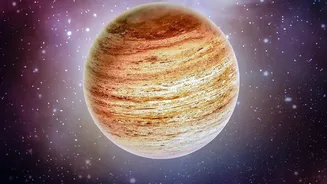
First, let's get acquainted with this intriguing world. Discovered in 2017, LHS 1140 b is what astronomers call a 'super-Earth'. It's about 1.7 times the size of our own planet and packs roughly 5.6 times the mass, suggesting a dense, rocky composition
much like Earth's. It orbits a small, cool red dwarf star, which is the most common type of star in our galaxy. Crucially, it orbits within its star's 'habitable zone'—the so-called Goldilocks region where temperatures are just right for liquid water to potentially exist on the surface, provided there's an atmosphere. While its position is promising, the planet itself is quite cool without a gaseous blanket, with a calculated temperature of around minus 47 degrees Celsius.
The Decisive Signal: Escaping Helium
So, how did scientists make this landmark confirmation? The breakthrough came from a team at Harvard's Center for Astrophysics, using the WINERED spectrograph on the Magellan Clay Telescope in Chile. They didn't see the atmosphere directly but detected a tell-tale sign: helium gas escaping from the planet's upper layers. Think of it like seeing steam rise from a pot of water. The steam itself isn't the whole story, but it proves there's a pot of water on the stove. Similarly, helium is a very light gas that slowly leaks into space from a planet's outer atmosphere. Detecting this leakage is powerful evidence that a thicker, more substantial atmosphere is sitting below it, constantly replenishing the supply. The discovery was especially exciting because earlier observations of the planet had been inconclusive or hinted at varying activity, making this definitive signal a huge step forward.
Why This Atmosphere is a Game-Changer
This isn't just another planetary discovery; it's a turning point. For years, scientists have found many rocky planets in habitable zones, but they were beginning to wonder if these worlds, especially those around active red dwarf stars, could even hold onto their atmospheres over billions of years. Many other candidates have turned out to be bare, airless rocks. LHS 1140 b proves that a rocky, temperate world can indeed retain its atmosphere. It single-handedly shifts the scientific quest from 'Do these planets have atmospheres?' to 'What is in these atmospheres?'. It provides a tangible target and renews hope that we can find worlds with the right conditions for life.
What We Know, and What We Don't
While we know there's an atmosphere, its exact composition remains a mystery that scientists are eager to solve. The helium detection was just the tip of the iceberg. Previous studies with the James Webb Space Telescope (JWST) had already ruled out a puffy, hydrogen-dominated atmosphere, suggesting something denser. The current theory is that the lower atmosphere, closer to the planet's surface, is likely composed of heavier gases such as nitrogen, carbon dioxide, and water vapor. In fact, some models suggest LHS 1140 b could be a 'water world,' with 10-20% of its mass being water—a far greater proportion than Earth's. But for now, these remain educated guesses that need further observation to confirm.
The Next Frontier: Enter the Webb Telescope
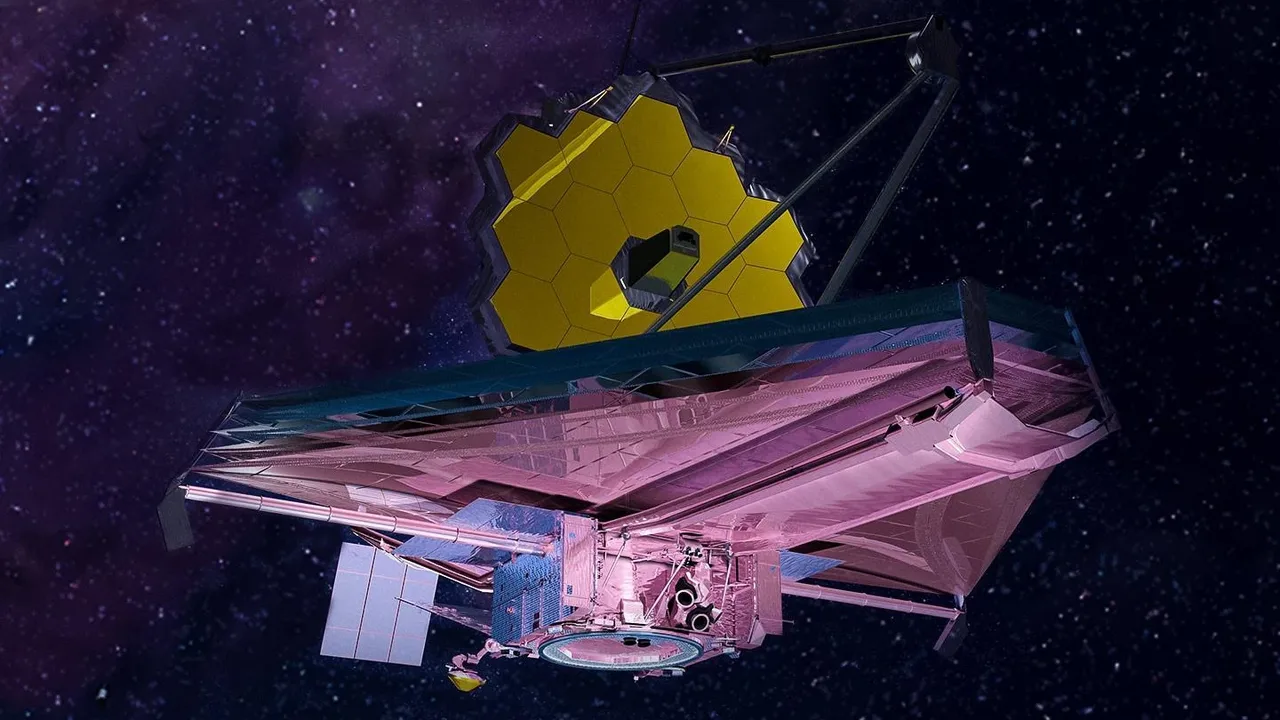
The discovery at the Magellan telescope has essentially handed the baton to the next generation of observatories. The James Webb Space Telescope (JWST) is perfectly suited for the next phase of investigation. Having already provided tantalizing hints about this world, the JWST will now be pointed at LHS 1140 b with a new, more focused goal: to parse the light filtering through its lower atmosphere. By doing so, scientists will hunt for the spectral fingerprints of molecules like methane, carbon dioxide, and, most importantly, water vapor and oxygen. These 'biosignatures' are the chemical signs of biological or geological activity that could point toward a truly living world. LHS 1140 b is already a prime target for a dedicated JWST program, and this confirmation will make those future observations among the most anticipated in modern astronomy.