







1. Chand Baori, Rajasthan
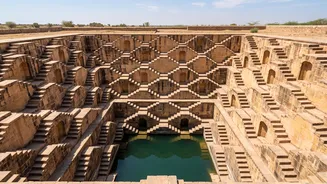
Perhaps the most famous stepwell in India, Chand Baori is a breathtaking sight in the village of Abhaneri. Built in the 9th century, it features 3,500 perfectly symmetrical steps that descend 13 storeys—making it one of the deepest and largest in the world.
This mesmerising geometric maze was not just a reliable water source in an arid region; its design ensured that the bottom remained significantly cooler than the surface, serving as a community gathering spot during intense summer heat.
2. Rani ki Vav, Gujarat
A UNESCO World Heritage site, Rani ki Vav (the Queen's Stepwell) is an exceptional example of subterranean architecture. Located on the banks of the Saraswati River in Patan, it was built in the 11th century by Queen Udayamati in memory of her husband, King Bhimdev I. Designed as an inverted temple, its seven levels are adorned with over 800 intricate sculptures of deities and mythological figures, showcasing the peak of Maru-Gurjara architectural style. After being buried by silt for centuries, it was excavated by the Archaeological Survey of India in the 1980s.
3. Adalaj Stepwell, Gujarat
This five-storey stepwell near Ahmedabad is a stunning fusion of Hindu and Islamic architectural styles. Its history is a dramatic tale of love and sacrifice. Started by a Hindu ruler, Rana Veer Singh, it was completed in 1499 by a Muslim king, Mahmud Begada, who sought to marry the widowed queen, Rudabai. She agreed, on the condition that he finish the well, but ultimately sacrificed her life to protect her honour. The octagonal structure is known for its intricately carved pillars, and the three separate entrances are a unique feature.
4. Agrasen ki Baoli, Delhi
Tucked away amidst the high-rises of central Delhi near Connaught Place, this protected monument offers a sudden, serene escape from the city's chaos. While its exact origins are debated, it is believed to have been originally built by the legendary King Agrasen during the Mahabharata era and later rebuilt in the 14th century. The stepwell features 108 steps that descend through a series of arched niches, creating a quiet and mysteriously cool atmosphere that has made it a popular spot for photographers and filmmakers.
5. Hampi Pushkarani, Karnataka
While many famous stepwells are in northern India, the sacred water tanks, or 'pushkaranis', of Hampi showcase a distinct southern style from the Vijayanagara Empire. The Stepped Tank within the Royal Enclosure is a highlight, known for its perfect pyramid-like symmetry. These tanks were not just for water storage; they were integral to temple rituals and festivals, connected by a sophisticated network of stone aqueducts that channelled water from the Tungabhadra River. They served as vital hubs for both sacred ceremonies and community life.
6. Surya Kund, Modhera
Located in the compound of the magnificent Sun Temple in Modhera, Gujarat, the Surya Kund is a rectangular stepwell that once served as a ceremonial space for purification rituals. Built in the 11th century during the Solanki dynasty, this vast tank is lined with 108 miniature shrines dedicated to various deities, a number considered auspicious in Hinduism. The geometric precision of its descending terraces and steps creates a visually stunning preface to the main temple, reflecting a profound understanding of both architecture and ritual.
7. Panna Meena ka Kund, Rajasthan
Located near Amer Fort in Jaipur, Panna Meena ka Kund is an eight-storey stepwell known for its unique crisscrossing staircases. Dating back to the 16th century, the design meant that the same flight of stairs could not be used to go down and come back up. Beyond its ingenious architecture for water conservation, this kund was a vital social hub where local women would gather, escaping the desert heat and sharing news. Its symmetrical beauty and tranquil atmosphere make it a hidden gem for those exploring the Amer area.
8. Rajon ki Baoli, Delhi
Hidden within Mehrauli Archaeological Park, Rajon ki Baoli is often overshadowed by Delhi's more famous monuments, but it is a grand structure in its own right. Commissioned in 1506 during the Lodi dynasty, its name translates to "masons' stepwell," likely because it was used by the masons who built it. The four-level stepwell includes a mosque and a tomb within its enclosure. Its covered arcades and cool, shaded rooms provided a resting place for travellers and locals, making it a perfect example of a multi-functional community space.